Volkswagen Dieselgate: How 'Clean Diesel' Became One of the Biggest Corporate Scandals in History
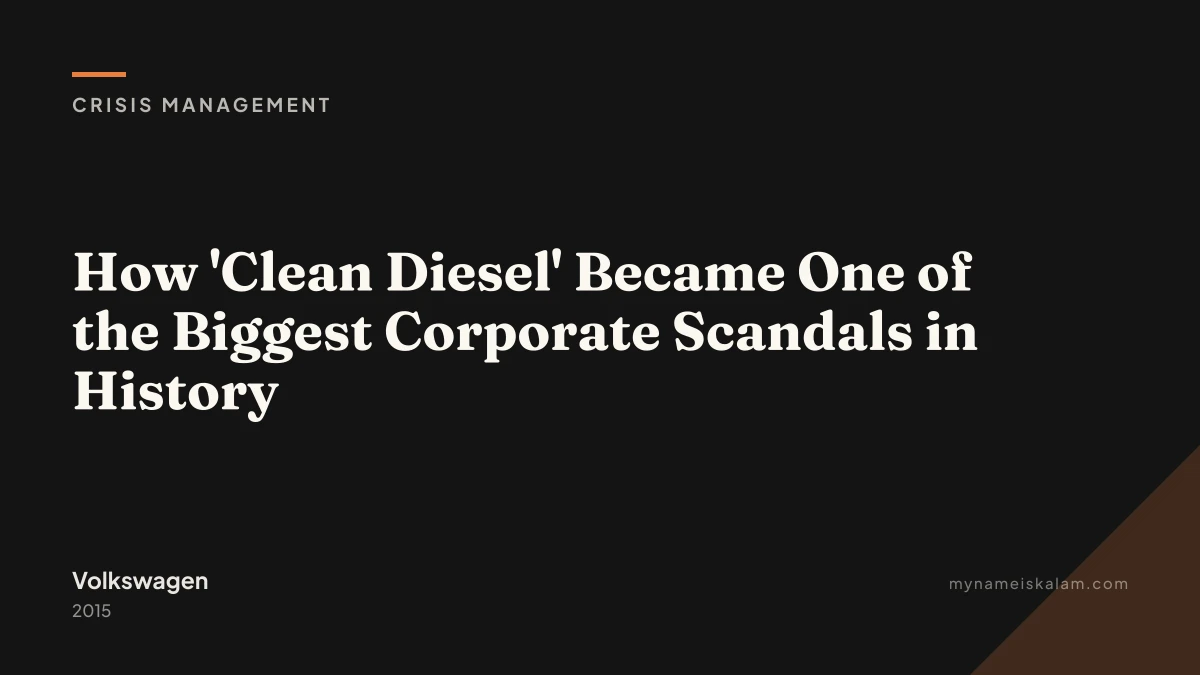
Volkswagen spent years marketing its diesel cars as clean, efficient and good for the environment. In 2015, US regulators revealed that the cars used software to cheat emissions tests. The scandal cost the company tens of billions and destroyed a marketing message it had built for a decade.

- Brand
- Volkswagen
- Year
- 2015
- Industry
- Automotive
In the late 2000s and early 2010s, Volkswagen had a powerful message for American drivers. Its diesel cars, it said, were clean, efficient and fun to drive. It called them “Clean Diesel.” Its ads showed diesel as a smart, green choice, and its cars won environmental awards.
In September 2015, the US Environmental Protection Agency announced that Volkswagen had installed software in its diesel cars that detected when they were being tested and reduced emissions only during the test. On the road, the cars emitted up to 40 times the legal limit of nitrogen oxides.
The scandal became known as Dieselgate.
The Context
Volkswagen wanted to become the world’s largest carmaker. Success in the US market was central to that goal. Diesel cars were popular in Europe, but American drivers associated diesel with dirty, noisy trucks.
Volkswagen set out to change that perception. It promoted “Clean Diesel” technology as offering the fuel economy of a hybrid with the performance of a regular car. The message was environmental as well as practical: diesel was presented as a responsible choice.
US emissions rules, especially for nitrogen oxides, were strict. Meeting them with diesel engines was expensive and difficult. Rather than admit that its engines could not meet the targets at an acceptable cost, some engineers developed software to cheat the tests.
The Campaign
Volkswagen’s marketing strongly promoted its diesel cars as clean. Ads highlighted fuel economy and low emissions. One series of ads featured elderly women arguing about whether diesel was dirty, with the car proving the doubters wrong. Volkswagen’s diesel models won “Green Car of the Year” awards.
The marketing was effective. Diesel sales grew, and Volkswagen became the leading seller of diesel passenger cars in the US.
Then independent road tests raised questions about the cars’ real-world emissions. In September 2015, after more than a year of investigation, the EPA publicly accused Volkswagen of cheating.
Volkswagen admitted the deception. It said around 11 million vehicles worldwide had the software.
The researchers who uncovered the problem were not looking for fraud. The International Council on Clean Transportation had commissioned tests to show that diesel cars could be clean, hoping to encourage cleaner technology in Europe. When the team at West Virginia University tested Volkswagen cars on the road with portable equipment, the results were far higher than expected. After months of questions from regulators, Volkswagen’s explanations did not hold up, and the company finally admitted the use of a “defeat device.”
The software was sophisticated. It detected the conditions of a laboratory test, such as the position of the steering wheel, speed and duration, and switched the engine into a mode that reduced emissions. In normal driving, the engine returned to a mode that delivered better performance and fuel economy but produced far more pollution.
The cheating affected several brands in the Volkswagen Group, including Audi, SEAT and Škoda, as well as Volkswagen itself. That broadened the damage to the group’s reputation across many markets.
Why It Failed
The product claim was false. The central marketing message, clean diesel, was untrue. When the truth came out, all the marketing that had built the message became evidence of deception.
The brand’s promise made the betrayal worse. Customers who bought the cars because they wanted to be environmentally responsible felt personally deceived. The environmental positioning turned a technical scandal into a moral one.
The culture enabled cheating. Investigations suggested a culture where employees felt they could not admit that targets were impossible. Pressure to succeed led to deliberate fraud.
The response was slow. Volkswagen had denied problems when researchers first raised questions. It only admitted the truth when regulators forced the issue.
The Results
The consequences were enormous. CEO Martin Winterkorn resigned within days. Volkswagen’s share price fell by about a third. The company faced fines, lawsuits and criminal charges in many countries, and several executives were prosecuted.
Volkswagen agreed to buy back or fix hundreds of thousands of cars in the US. Total costs, including fines, settlements and repairs, exceeded €30 billion.
The scandal also changed the car industry. Diesel’s reputation collapsed, particularly in Europe, and sales of diesel cars fell sharply. Governments tightened emissions testing.
Volkswagen responded by investing heavily in electric vehicles, launching its ID family and rebranding with a new, simpler logo in 2019. The company presented electrification as a fresh start.
The marketing response after the scandal was cautious. Volkswagen ran apology ads in newspapers and on TV, stating that it had broken customers’ trust and promising to make things right. It later shifted its message to the future, focusing on electric cars and a cleaner image. Many observers noted the irony of a company that had cheated on emissions now presenting itself as a leader in clean transport.
The long-term impact on the brand was mixed. Volkswagen’s sales recovered in many markets within a few years, partly because many customers valued the cars’ quality and partly because the scandal affected the diesel category broadly. But the episode remains one of the most expensive corporate scandals in history and a standard case study in business ethics.
The Lesson for Today’s Marketers
Never market a claim you cannot support. Marketing amplifies whatever is true about a product, and it amplifies the damage when the claim turns out to be false.
Purpose-driven positioning raises the stakes. When a brand builds its reputation on values, customers feel betrayed, not just disappointed, when those values are broken.
And culture is a marketing issue. A company that punishes honesty will eventually produce a crisis that no campaign can fix.
Key results
About 11 million diesel vehicles worldwide were fitted with software designed to cheat emissions tests
Fines, settlements, buybacks and repairs cost Volkswagen more than €30 billion
CEO Martin Winterkorn resigned within days of the scandal becoming public
Volkswagen's share price fell by about a third in the days after the revelation
SWOT analysis
S Strengths
- Volkswagen was one of the world's largest and most trusted carmakers
- Its diesel cars were popular for their performance and fuel economy
W Weaknesses
- The 'clean diesel' message rested on a lie
- A culture that allowed engineers to cheat rather than admit targets could not be met
O Opportunities
- Growing demand for greener cars
- The chance to rebuild the brand around electric vehicles
T Threats
- Regulators, lawsuits and criminal charges
- Loss of trust among customers and the public
Dieselgate showed that marketing cannot protect a brand when the product claim is false. Volkswagen built its reputation on clean diesel, and when the truth came out, the marketing made the betrayal worse.
Want help with this for your brand? See my services.
Enjoying our content? Make us a preferred source on Google.
Add as Preferred Source