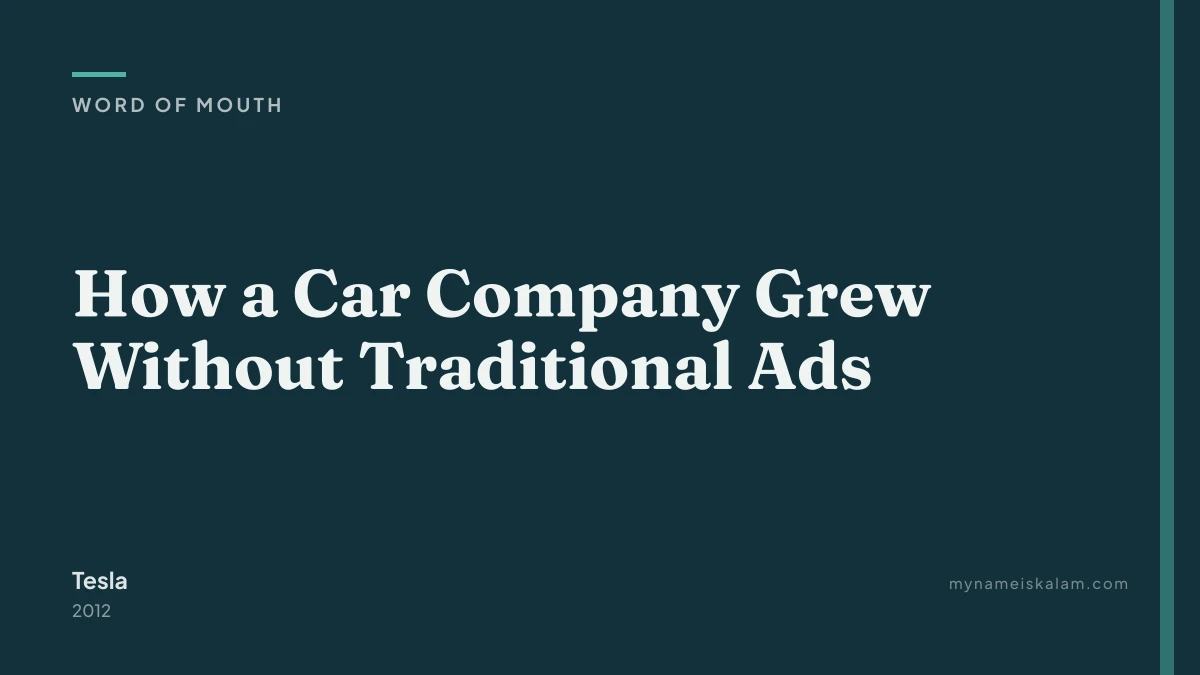
Tesla's Zero-Advertising Strategy: How a Car Company Grew Without Traditional Ads
Car companies spend billions on advertising every year. For most of its rise, Tesla spent almost nothing on traditional ads. It relied on its products, its CEO's public profile, launch events and customer referrals instead.

- Brand
- Tesla
- Year
- 2012
- Industry
- Automotive, Technology
Every year, the world’s big carmakers spend billions of dollars on advertising. TV commercials, billboards, magazine spreads and sponsorships are part of how cars are sold.
For most of its rise, Tesla spent almost none of that. It did not run traditional TV ads or large print campaigns. Yet it became the world’s most valuable carmaker.
The Context
Tesla launched its first car, the Roadster, in 2008. It was an expensive electric sports car, built in small numbers. The company’s real goal was to build more affordable electric cars for the mass market, but it did not have the budgets of established carmakers.
Tesla also sold directly to customers rather than through dealerships. This meant it controlled the sales experience but could not rely on dealers’ local advertising.
Elon Musk, Tesla’s CEO, had strong opinions about marketing. He argued that money should be spent on making the product better rather than advertising it.
The Campaign
Tesla’s approach was built on several elements rather than a single campaign.
The product. Tesla focused on cars that people would talk about: fast acceleration, long range, large touchscreens and software updates delivered over the air. Owners often showed off features to friends and family.
Launch events. Tesla unveiled its cars at dramatic events that were streamed online and covered by the media. In March 2016, the Model 3 unveiling led to more than 325,000 reservations within about a week, according to Tesla, each with a refundable deposit. In 2019, the Cybertruck’s unveiling was remembered for a demonstration in which its “armoured” window cracked on stage, which generated even more coverage.
The CEO. Musk used Twitter to talk directly to millions of followers, announcing products, answering customers and making news. His public profile meant Tesla was rarely out of the headlines.
Showrooms. Tesla placed stores in shopping malls, where people could see the cars while shopping, rather than in car dealership areas.
Referrals. Tesla ran referral programmes that rewarded owners for recommending the cars to friends, with prizes including free charging and exclusive events.
Tesla’s approach also relied on unusual product decisions that created stories. Cars received software updates over the internet, sometimes adding new features overnight. Owners discovered hidden games and jokes, known as easter eggs, in the car’s software. Features such as “Ludicrous Mode” for faster acceleration had names designed to be talked about. Each update gave owners, journalists and YouTubers something new to share.
The company’s Supercharger network was another marketing asset. Tesla built its own fast-charging stations along major routes, which addressed a common worry about electric cars: running out of charge on a long journey. The network made Tesla ownership more practical and gave the brand a visible presence on highways.
Tesla’s showrooms were designed to educate rather than sell. Staff were not paid on commission in the early years, and visitors could look at the cars and ask questions without pressure. The stores worked more like brand experiences than car dealerships.
Why It Worked
The product generated conversation. Tesla cars had features that people wanted to show off. Owners became advocates, spreading word of mouth that no ad could match.
Attention was free. Musk’s public profile, launch events and Tesla’s bold claims generated huge amounts of media coverage at little cost.
The story was compelling. Tesla positioned itself as a company changing the car industry and fighting climate change. That story attracted media interest and early adopters.
Direct sales supported the message. By controlling the sales experience, Tesla made sure customers heard its story directly rather than through dealers.
Referrals turned owners into salespeople. Rewarding recommendations encouraged owners to share their enthusiasm with friends.
The Results
Tesla grew from a niche company into the world’s largest electric vehicle maker. In 2020 it became the most valuable carmaker in the world by market capitalisation.
The approach had limits. As competition increased, Tesla’s sales growth slowed in some markets. In 2023 Musk said Tesla would try a small amount of advertising. And the company’s reliance on Musk’s public profile became a risk as his political views and behaviour became controversial, leading some customers to reconsider the brand.
Tesla’s approach also had costs that were less visible. Without advertising, the brand’s image was shaped largely by media coverage and by Musk’s own posts. When coverage focused on production delays, safety investigations or controversies, Tesla had few paid channels to tell its own story. The company’s reputation became closely tied to news cycles.
By the mid-2020s, the brand faced increased competition from established carmakers and from Chinese manufacturers such as BYD, which offered electric cars at lower prices. Musk’s political activities also became a major factor in how many customers saw the brand, with protests at Tesla stores in some countries and reports of owners distancing themselves from the company. The zero-advertising strategy had helped build the brand, but it left Tesla more exposed when public opinion shifted.
The Lesson for Today’s Marketers
A product people want to talk about is the best marketing asset a company can have. Tesla built features that owners wanted to show others.
Founder-led marketing can be extremely powerful. A founder with a large following can generate attention that would cost millions to buy. But it is a double-edged sword: when the founder’s reputation changes, the brand’s reputation changes too.
Finally, no strategy lasts forever. As markets become more competitive, even companies that grew without advertising may need to rethink their approach.
Key results
Tesla reported more than 325,000 reservations for the Model 3 within about a week of its unveiling in 2016
For years Tesla spent almost nothing on traditional paid advertising, compared with billions spent by established carmakers
Customer referral rewards gave owners incentives to recommend the cars to friends
Tesla became the world's most valuable carmaker by market capitalisation in 2020
SWOT analysis
S Strengths
- Products that people wanted to talk about
- A CEO with a huge public following who generated constant attention
- Launch events designed to create news
- Direct sales and showrooms in shopping malls
W Weaknesses
- Heavy dependence on one person's reputation
- Controversy around the CEO could affect the brand
- Without ads, the company had less control over its message
O Opportunities
- Growing interest in electric vehicles and climate change
- Social media allowed direct communication with customers
T Threats
- Established carmakers launching electric models
- Political controversy linked to the CEO
Tesla showed that products people want to talk about, combined with a founder who commands attention, can replace traditional advertising. But relying on one person's voice means the brand's reputation moves with his.
Want help with this for your brand? See my services.
Enjoying our content? Make us a preferred source on Google.
Add as Preferred Source