Stranger Things x Burger King: The Upside Down Whopper That Ate Netflix's Marketing Budget
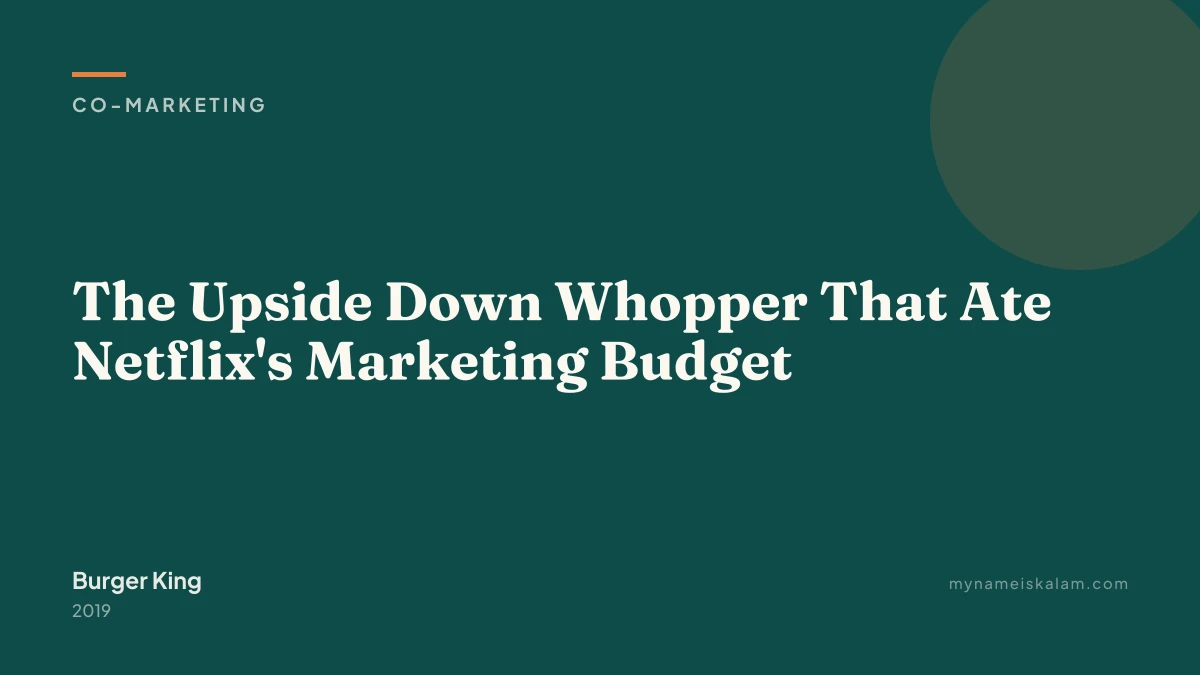
For the launch of Stranger Things Season 3 in 2019, Burger King sold a Whopper served upside down — bun on the bottom, sesame seeds facing the tray. It sounds like a cheap stunt. It got over 6 billion media impressions. And it didn't cost Netflix a dollar.
The pitch must have been about thirty seconds long. “We serve the Whopper upside down. Because the Upside Down. From Stranger Things.” There isn’t much more to say. The genius of the Upside Down Whopper was that it required no explanation, no consumer education, no brand storytelling. You saw a photo of a burger with the bun facing the wrong way and you immediately got it. On social media in 2019, that kind of instant comprehension is worth more than any amount of clever copy.
What made it remarkable wasn’t the idea itself. It was the execution: Burger King actually put the thing on the menu, globally, in time for Stranger Things Season 3’s July 4, 2019 premiere. The follow-through turned a visual pun into a genuine marketing event.
The Context
By mid-2019, Stranger Things was arguably Netflix’s most culturally dominant property. The first two seasons had generated passionate fandoms, relentless meme culture, and the kind of nostalgic 1980s aesthetic that spreads effortlessly across social platforms. Season 3 had been building anticipation for over a year. Netflix was about to release the most-watched season yet, and the internet was ready to flood with Upside Down references the moment the show dropped.
Netflix’s own marketing for season launches was, by 2019, substantial and sophisticated — trailers, social campaigns, press junkets, strategic partnerships. But Netflix’s marketing budget, however large, is finite, and the company has always been smart about finding ways to extend its launch presence through earned rather than paid media. A fast food chain putting a show-themed item on the menu in dozens of countries is effectively a distributed billboard network that the chain’s paying for.
Burger King, for its part, had been on a creative run. Under the influence of David Miami as its agency, the brand had leaned into provocative, self-aware marketing. The Whopper Detour (ordering a Whopper from inside a McDonald’s via geofencing) had run in late 2018 and generated enormous press. The brand was in the habit of looking for marketing ideas that were genuinely weird rather than merely promotional.
The Campaign
The partnership gave Burger King a physical, photographable product that connected to one of the biggest pop culture moments of the year. The Upside Down Whopper was a standard Whopper, served with the bun inverted so the sesame seed side faced down and the flat side faced up. That’s it. That was the product modification.
On its own, an upside-down burger is a mildly amusing gag. In the context of a show literally called “The Upside Down” — where an alternate dimension mirrors the real world in inverted, darkened form — the burger was a piece of physical fan service. People who loved the show got the reference immediately. People who didn’t know the show were curious about why a burger was upside down, which drew them into the cultural conversation around the launch.
The rollout was coordinated with the Season 3 premiere date. Burger King markets in the United States, United Kingdom, and dozens of other countries put the item on the menu simultaneously. The social media assets were ready: photos of the burger in official Stranger Things visual language, packaging with the show’s typography. Burger King’s social team pushed the content at the same moment Netflix fans were already online consuming and sharing launch content.
The international dimension was underappreciated at the time. Most co-marketing stunts are domestic by default, with international markets getting watered-down versions or nothing. The Upside Down Whopper launched across markets with enough scale that it generated press in countries where Burger King’s presence might otherwise not make news. That amplification — 25 countries worth of food press and entertainment press covering the same product — contributed materially to the 6 billion impressions figure.
Why It Worked
There’s a test for any co-branded campaign: does the partnership make both brands better, or does it just make one brand better while the other pays? The Upside Down Whopper passed this test better for Burger King than for Netflix, but Netflix got something real out of it too.
For Burger King, the benefit was clear. Launching a globally available product in coordination with the biggest TV premiere of the summer generated press coverage across food media, entertainment media, and marketing trade press simultaneously. Those three audiences rarely overlap. A campaign that gets written up in AdWeek, Entertainment Weekly, and Food & Wine is reaching audiences that any single media buy would struggle to cover. The earned media value exceeded the cost of running a slightly unusual burger for a few weeks.
For Netflix, the benefit was more diffuse but genuine: a global food chain with millions of daily customers was actively promoting Stranger Things Season 3 in its stores, on its social channels, and through the press the partnership generated. That’s distribution for the show’s cultural presence that Netflix didn’t have to fund. Netflix’s team understood they were getting the better end of that deal in media terms and was willing to license the IP accordingly.
The visual simplicity was essential. An upside-down burger photographs in one second, reads instantly, and requires no caption to understand. Campaigns that require explanation don’t travel. The Upside Down Whopper could be understood in a thumbnail, which meant it worked as a tweet, an Instagram post, a news photo, and a TV segment graphic. That versatility of format is what produces 6 billion impressions rather than 600 million.
Burger King’s established reputation for mischief also mattered. A surprise product launch from McDonald’s, which trades on consistency and family, might have read as odd. From Burger King, which has spent years signaling a willingness to be strange, an upside-down burger felt like brand behavior rather than a departure from it.
The Results
The Upside Down Whopper generated over 6 billion media impressions globally, according to figures Burger King’s marketing team reported. Press coverage appeared in more than 25 countries across food, entertainment, and general news categories. Social engagement on Burger King’s accounts spiked during the premiere week. The campaign was nominated for industry awards in multiple markets and became a frequently cited example in case studies about entertainment IP partnerships.
What’s harder to measure, but worth noting, is the halo effect for both brands. Burger King was associated with one of the most anticipated TV launches of the year. Stranger Things got a physical product presence in fast food restaurants across dozens of markets. In terms of cultural ubiquity during that specific window — the first week of July 2019 — you could hardly avoid either brand.
The Lesson for Today’s Marketers
Entertainment IP partnerships are now a standard tactic in fast food and consumer goods marketing. McDonald’s has done character collaborations, limited menus around film releases, and full celebrity meal campaigns. Every major QSR has a playbook for this. But what made the Upside Down Whopper work in 2019 — before that playbook was fully codified — was the constraint the creative team accepted.
They didn’t build a new burger. They didn’t change the ingredients or the flavor. They flipped an existing product upside down and called it a day. That’s creative work that came from inside the brief rather than around it. The brief said “connect to Stranger Things” and the solution used the show’s central concept (the Upside Down) in the most literal, physical way possible.
Simple ideas that are true to the source material and easy to photograph beat complex campaigns that require a consumer to care about the marketing itself. The Upside Down Whopper asked nothing of the audience except recognition — and recognition was everywhere because the show was everywhere. That’s the condition to look for: when a piece of culture is already at saturation point, the best co-marketing is the one that gets out of the way and lets the culture do the work.
Key Results
- Media impressions: Over 6 billion media impressions globally
- Press coverage: Covered by major media outlets in over 25 countries
- Social engagement: Burger King's social engagement spiked significantly during the Stranger Things Season 3 premiere week
- Menu availability: Available in US, UK, and dozens of international markets
SWOT Analysis
| Strengths | Weaknesses | Opportunities | Threats |
|---|---|---|---|
|
|
|
|
Key Takeaway
The Upside Down Whopper was a masterclass in constraint-based creativity. Burger King had one visual pun available to them and they committed to it completely. Simple ideas that photograph well and travel instantly across social platforms are worth more than complex campaigns that require explanation.
Enjoying our content? Make us a preferred source on Google.
Add as Preferred Source