The Marlboro Man Campaign Case Study: How a Feminine Cigarette Brand Became the Best-Selling in the World
In 1954, Leo Burnett took a cigarette marketed with the tagline 'Mild as May' and turned it into the best-selling cigarette in the world. He did it by inventing a cowboy.

- Brand
- Marlboro
- Year
- 1954
- Agency
- Leo Burnett
- Industry
- Tobacco
Before 1954, Marlboro was a women’s cigarette. Philip Morris marketed it with a red beauty tip (so lipstick wouldn’t show) and the tagline “Mild as May.” It had a small but defined market, and that market was largely female. That was Marlboro’s entire identity.
Leo Burnett, founder of the Chicago agency that bore his name, looked at this mild women’s cigarette and saw an opportunity to make it something else entirely. What he made it into was a myth. And that myth, in the form of a sun-weathered cowboy on an open range, became one of the most powerful brand images in advertising history.
The Context
The early 1950s were an anxious time for the tobacco industry. Research linking cigarettes to lung cancer was beginning to surface publicly, and filtered cigarettes were becoming a way for health-concerned smokers to feel better about the habit. The problem was that filters, in the male-dominated culture of the 1950s, carried a slightly feminine connotation. Real men smoked unfiltered cigarettes. Filters were for women and the worried.
Philip Morris had a filtered cigarette that was already being marketed to women. The question they brought to Leo Burnett was whether they could make a filtered cigarette feel masculine. Could you take a product that was explicitly coded as gentle and feminine and convince men that smoking it was a statement about who they were?
The postwar American man was navigating his own cultural anxieties. The frontier was closed. Industrial work was replacing physical labor. Suburban life was comfortable but confining. The cowboy, already a figure of nostalgia rather than reality, represented everything that corporate suburban life wasn’t: independence, physical skill, connection to open land, a kind of rugged competence that office work didn’t provide.
Burnett understood that he wasn’t selling a cigarette. He was selling a version of masculinity that American men wanted to feel connected to, even if they lived in Evanston and drove a station wagon.
The Campaign
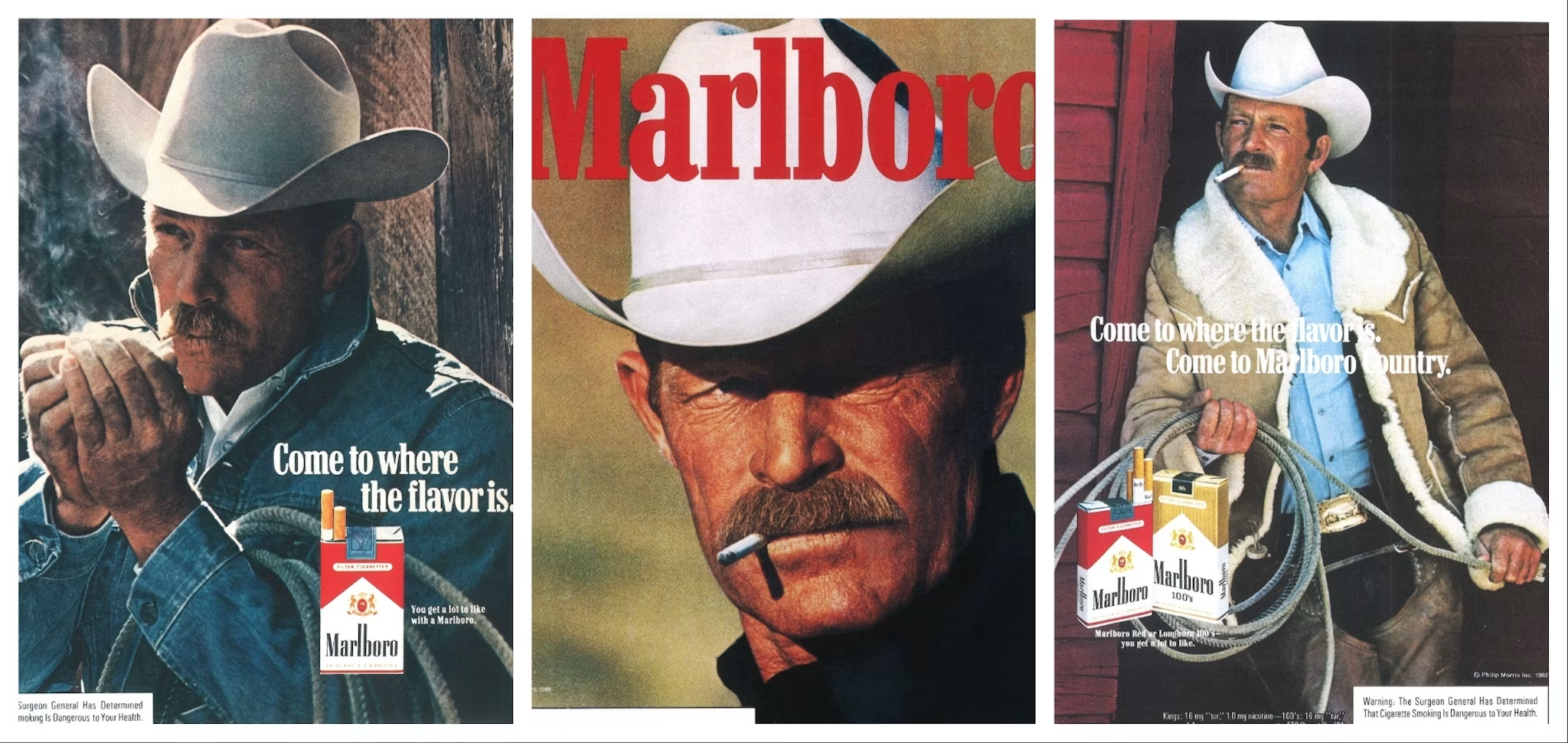
The Marlboro Man was, from the beginning, a visual idea rather than a verbal one. Burnett’s insight was that you could communicate everything you needed to through imagery alone: a man, a horse, wide landscape, a specific quality of light. The copy was minimal. In many executions, there was almost none.
The initial campaigns featured several masculine archetypes, not just cowboys, including construction workers, sea captains, and athletes. But the cowboy image proved so resonant that it eventually crowded out everything else. By the late 1950s, the Marlboro Man was synonymous with the cowboy, and the campaign had found its permanent visual language.
Philip Morris also made a product change that is easy to overlook. They put a red band on the filter, ostensibly as a design choice, but functionally as a way to hide lipstick marks. The product signal said: this filter is for men. The advertising said: this filter is for men. The two elements reinforced each other in a way that pure advertising couldn’t have achieved alone.
The photography was shot in the American West, mostly in Texas and other wide-landscape states. The light was golden and specific. The horses were real. The men in the ads were often actual working men rather than models, which gave the images a texture that studio work would have lacked. You believed them. They looked like people who knew what they were doing outdoors.
The tagline that eventually settled in was simply “Come to Marlboro Country.” The word “country” did a lot of work: it wasn’t just a geographic description but an invitation to a state of being, a mythology with a specific visual grammar that anyone could recognize.
Why It Worked
The repositioning succeeded for reasons that are worth separating clearly.
First, it identified a genuine emotional gap. American men in the 1950s had real anxieties about masculinity, about what it meant to be a man in a world that was increasingly white-collar and domesticated. The frontier mythology the Marlboro Man drew on didn’t need to be explained because every American had absorbed it from Westerns, from history class, from the cultural air. Burnett didn’t create the mythology; he borrowed it and applied it to a product.
Second, the campaign committed completely to a single image. There was no hedging, no “but also our cigarette is mild,” no attempt to appeal to multiple audiences. The Marlboro Man was singular. Singularity in advertising is much harder than it looks. The organizational impulse is always to broaden, to add another message, to speak to one more segment. Burnett held the line.
Third, and most practically, the product change worked in tandem with the advertising. A masculine-coded filter gave smokers a physical object that matched the image they’d been shown. The advertising created desire; the redesigned product delivered on it in a tangible way every time someone pulled a cigarette out of the pack.
The Results
Marlboro’s share of the US cigarette market was under 1 percent before the repositioning. Within a few years of the Marlboro Man campaign’s launch, it had climbed dramatically. By the 1970s, Marlboro was the best-selling cigarette in the United States and was well on its way to becoming the best-selling cigarette in the world, a position it held for decades.
Philip Morris extended the campaign internationally, and the American West imagery translated globally. The aspiration for American frontier culture wasn’t limited to Americans. In markets across Europe, Asia, and Latin America, the Marlboro Man carried essentially the same meaning: freedom, rugged independence, a specifically American flavor of masculine self-determination.
The campaign ran in various forms for over 40 years. When US regulations eventually constrained tobacco advertising in print and broadcast, Marlboro extended the brand through Formula 1 racing sponsorship and other venues, adapting the underlying masculine adventure imagery to new contexts while the regulatory environment tightened.
The Lesson for Today’s Marketers
The Marlboro Man’s story requires two conversations, and they’re genuinely separate.
The advertising achievement is real. Burnett took a brand with an incompatible identity, found a coherent alternative that connected to deep cultural mythology, committed to a single visual language, and executed it with enough consistency and quality that the campaign ran for four decades. As a study in repositioning mechanics, it’s about as clear an example as advertising history offers.
The ethical dimension is also real and can’t be footnoted away. The campaign sold a product that kills people who use it as directed. Several of the men who modeled as the Marlboro Man died of smoking-related illnesses, and their deaths became anti-tobacco campaign material. Wayne McLaren and David McLean both died of lung cancer, and both spoke publicly about the irony before their deaths. The campaign’s success contributed to tobacco industry profits during a period when the industry suppressed evidence about health risks.
For advertising practitioners, the applicable lesson is about repositioning mechanics: when a brand has a deeply established identity that the business needs to change, visual language shifts faster than verbal arguments. People don’t reason their way into a brand identity; they absorb it through accumulated visual and emotional impressions. Change the imagery completely, commit to the new direction without hedging, and support the advertising with product signals that reinforce the new meaning. Marlboro did all three simultaneously. That’s why the repositioning happened as fast as it did.
What you do with that knowledge is, as always, a separate question.
Key results
Marlboro grew from under 1% US market share before the repositioning to the best-selling cigarette in the United States within roughly a decade
Philip Morris extended the campaign internationally, and Marlboro became the world's best-selling cigarette brand by the 1970s
One of the fastest brand repositioning successes in advertising history, with substantial market share gains within the first few years of the campaign
The Marlboro Man ran in various forms for over 40 years before US tobacco advertising restrictions effectively ended the campaign
SWOT analysis
S Strengths
- The cowboy archetype tapped into a mythological American self-image that transcended demographic categories, speaking to male aspiration broadly
- The visual language was so distinct and simple that it required almost no copy: the landscape and the figure did all the work
- Philip Morris simultaneously filtered the cigarette (adding a red-band filter to hide lipstick), giving the repositioning a physical product signal to match the campaign
W Weaknesses
- The campaign was built on cultural imagery that was already becoming nostalgic in the 1950s; cowboys were romanticized precisely because the frontier was over
- The masculine archetype eventually locked Marlboro out of the growing female smoker market, which competitors captured
O Opportunities
- The campaign's visual language transferred easily to international markets, where the American West carried its own aspirational mythology independent of the local culture
- Sponsorship of Formula 1 racing in later decades extended the masculine adventure imagery into a contemporary context when cowboy imagery aged
T Threats
- Several of the men who posed as the Marlboro Man died of smoking-related illnesses; Wayne McLaren and David McLean both died of lung cancer, generating significant negative press
- The 1971 US ban on broadcast tobacco advertising and eventual restrictions on print advertising dismantled the campaign's distribution channels
- The Marlboro Man became a symbol used by anti-tobacco advocates specifically because his iconic status made him useful for counter-messaging
Repositioning a brand isn't about changing the product description - it's about changing whose self-image the product reflects, and visual language does that work faster and more durably than copy ever will.
Frameworks at play
Enjoying our content? Make us a preferred source on Google.
Add as Preferred Source