
When to Fight Back: Hertz and the Art of the Competitor Response
Avis admitted it was number two and built a brand around trying harder. Hertz ignored it, then watched its lead erode. When Hertz finally responded, the ad became a textbook in how to fight back without ceding the narrative.

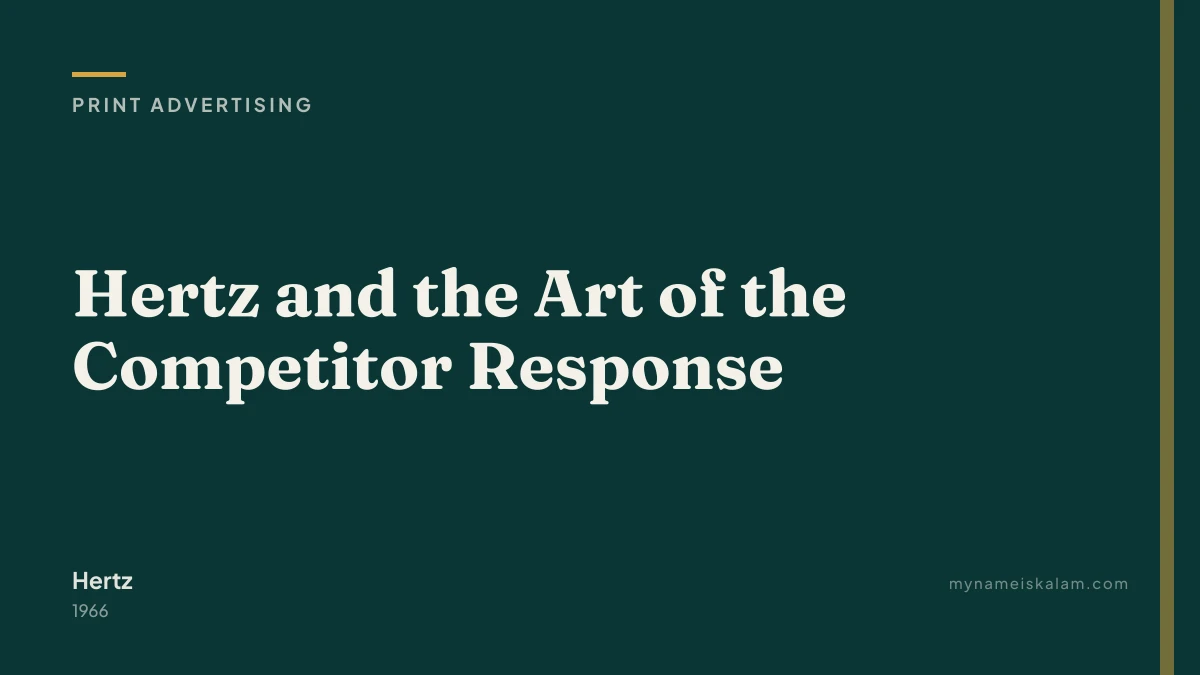
- Brand
- Hertz
- Year
- 1966
- Industry
- Travel & Hospitality
For years, Avis was telling you Hertz is number one. Then Hertz decided it was time to tell you why.
That sentence, essentially the thesis of one of advertising’s most discussed competitive responses, arrived years later than it should have. By the time Hertz published its retort to Avis’s “We Try Harder” campaign, Avis had already used its self-styled underdog positioning to nearly double its market share. The lesson isn’t just in what Hertz said. It’s in how long they waited to say it, and what that silence cost.
The Context
The car rental industry in the early 1960s was Hertz’s industry. They had invented the concept of airport car rental at scale. They were larger, older, and more profitable than any competitor, and their dominance seemed unassailable. Avis existed, and so did National, but the gap between Hertz and everyone else was substantial.
In 1962, Avis hired Doyle Dane Bernbach, the same agency that had created VW’s “Think Small” and “Lemon” campaigns, and gave them what appeared to be an impossible brief: help a company that is definitively second place compete with a company that is definitively first. DDB’s response became one of the most famous strategic pivots in advertising history.
The Avis “We Try Harder” campaign didn’t try to argue that Avis was better than Hertz. It argued that being second was the reason Avis tried harder. “When you’re not the biggest, you have to be the best.” The campaign ran the first ad that directly named its own disadvantage as its advantage, and it did so with complete conviction. Avis moved from 11% market share to 35% over the course of the campaign.
Hertz’s response, for years, was silence.
The Campaign
Hertz’s decision not to respond initially was not unreasonable. Market leaders who respond to challengers risk elevating them. When you’re number one and you start talking about number two, you implicitly acknowledge that number two matters. Conventional wisdom said ignore Avis, let the positioning play out, trust in Hertz’s structural advantages.
The problem was that the Avis campaign was too good to ignore. DDB had done something unusual: they’d created an emotional connection between consumers and a car rental company based on the underdog narrative. People were rooting for Avis. That kind of sentiment is dangerous for a market leader, because market leaders are supposed to be the obvious choice, and nobody roots for the obvious choice.
When Hertz finally responded, the ad that resulted was a masterclass in market leader tone. The headline was characteristically direct: “For years, Avis has been telling you Hertz is No. 1. Now we’re going to tell you why.”
The copy then delivered on that promise with specifics. More locations. More cars. More airport coverage. Faster service. Hertz didn’t dismiss Avis’s “We Try Harder” claim; instead, it acknowledged it and then asked a pointed question: trying harder is admirable, but what does first place actually look like in practice? The answer, according to Hertz, was concrete and measurable advantages, not just a commitment to effort.
The creative decision not to be defensive was critical. A defensive response from a market leader sounds anxious, which is the last thing a market leader wants to convey. Hertz’s ad read as confident, even slightly amused by the years of Avis positioning it had allowed to run unchallenged. It was the response of a company that had been patient, watched carefully, and decided that the time to speak had arrived.
Why It Worked
The response worked primarily because of its tone. There’s a specific register that market leaders can occupy that challengers cannot: the calm, unhurried certainty of a company that knows exactly where it stands. Hertz’s ad inhabited that register without tipping into arrogance. It didn’t mock Avis or dismiss their success. It simply explained what number one actually meant in tangible terms.
The structure of the argument was also sound. Avis’s “We Try Harder” was an emotional claim built on an identity. Hertz’s response was a factual claim built on evidence. Against an emotional campaign, a rational counter-argument often underperforms. But Hertz’s facts weren’t dry specifications; they were translated into consumer benefits. More locations isn’t an operational metric, it means you can pick up a car where you’re going, not just where they happen to have one.
The decision to engage directly with the “We Try Harder” framing rather than ignore it was also correct at this stage. By 1966, Avis’s campaign was so culturally embedded that Hertz had no choice but to address it. Any response that failed to acknowledge the positioning Avis had built would have seemed tone-deaf. By naming it and then systematically dismantling the implication that effort mattered more than results, Hertz shifted the conversation to terrain it controlled.
There’s a strategic principle at work here that goes beyond car rentals. When a challenger runs a sustained positioning campaign that gains cultural traction, the market leader’s silence eventually becomes an endorsement. By not contradicting Avis for years, Hertz allowed the “We Try Harder” story to become the assumed truth about the car rental industry. Responding late is better than not responding, but Hertz’s experience illustrates why the calculus needs to be constantly reassessed.
The Results
The immediate commercial impact of Hertz’s response was stabilization rather than reversal. The erosion of market share that had accompanied Avis’s “We Try Harder” campaign slowed and stopped. Hertz remained the market leader, though the gap between first and second place never returned to what it had been before DDB got hold of Avis’s brief.
The longer-term significance was strategic clarity. Hertz’s response defined what leadership looked like in the car rental category: scale, coverage, availability, and reliability. These attributes became the dimensions on which car rental competition was understood, which suited Hertz better than the emotional underdog narrative that Avis had introduced.
Both companies benefited from the rivalry in ways that transcend market share. The Cola Wars between Pepsi and Coke, the Mac versus PC debate, the Hertz-Avis competition - these sustained rivalries generate category attention that grows the total market for both participants. Consumers who are aware of a competition think more about the category and engage more deeply with the choice. Hertz and Avis together made car rental more salient than either could have alone.
The Lesson for Today’s Marketers
The Hertz case raises a question every market leader eventually faces: when does a challenger’s campaign become too strong to ignore?
The answer isn’t simple, and it depends on how deeply the challenger’s positioning has penetrated consumer consciousness. In the early years of “We Try Harder,” ignoring Avis was defensible. By the mid-1960s, with Avis’s market share nearly tripling, silence had become complicity. The threshold for responding is roughly when staying silent starts to feel like agreement.
The response itself offers its own lessons. If you must respond to a competitor, do it from your strongest position. Don’t apologize for being number one. Don’t explain why the challenger’s framing is unfair. Instead, accept the frame and then explain what winning inside that frame actually looks like.
Hertz said, in effect: yes, we’re number one. Here’s what that means for you as a customer. That’s the right structure. The market leader who sounds threatened is in trouble. The market leader who sounds amused, certain, and willing to explain exactly why they’re still the best choice is the one who stabilizes the battle.
The practical mistake was timing. Hertz waited too long. In advertising rivalries, as in many competitive dynamics, the first compelling story tends to define the terms for everyone who comes later. Avis got to write the narrative of the car rental industry’s competitive dynamic, and Hertz spent years playing inside a frame it didn’t build. The lesson is to respond early or respond emphatically, but don’t drift into a years-long silence while your competitor redefines the category around their own story.
Key results
Avis grew from 11% to 35% market share during the 'We Try Harder' campaign years
Hertz halted market share erosion and restabilized its position as clear market leader
Widely studied as the model for confident market-leader competitive response advertising
SWOT analysis
S Strengths
- Hertz's response used Avis's own narrative against them, acknowledging 'We Try Harder' while explaining why it wasn't enough
- Tone of calm confidence rather than defensiveness preserved market leader authority
- Specificity of claims gave consumers concrete reasons to stay with Hertz
W Weaknesses
- By responding at all, Hertz elevated Avis and validated the premise that they were serious competition
- Years of silence before responding had already allowed Avis to capture a significant share story
O Opportunities
- Hertz's actual service advantages, airport locations, fleet size, and loyalty programs, were real and demonstrable
- Consumer confusion created by Avis's growth gave Hertz a chance to remind people what being number one meant
T Threats
- Any misstep in tone risked making Hertz look arrogant or out of touch
- Responding kept the conversation about the rivalry alive, which benefited the underdog
Market leaders face a strategic trap when challengers go comparative: responding validates the fight, but staying silent cedes the narrative. Hertz's eventual response shows how to re-enter the conversation from a position of strength rather than defensiveness.
Want help with this for your brand? See my services.
Concepts in this case study
Enjoying our content? Make us a preferred source on Google.
Add as Preferred Source