Wonderbra "Hello Boys": The Billboard That Stopped Traffic
Two words on a billboard made Wonderbra the most talked-about brand in Britain and turned a Czech model into an international icon.
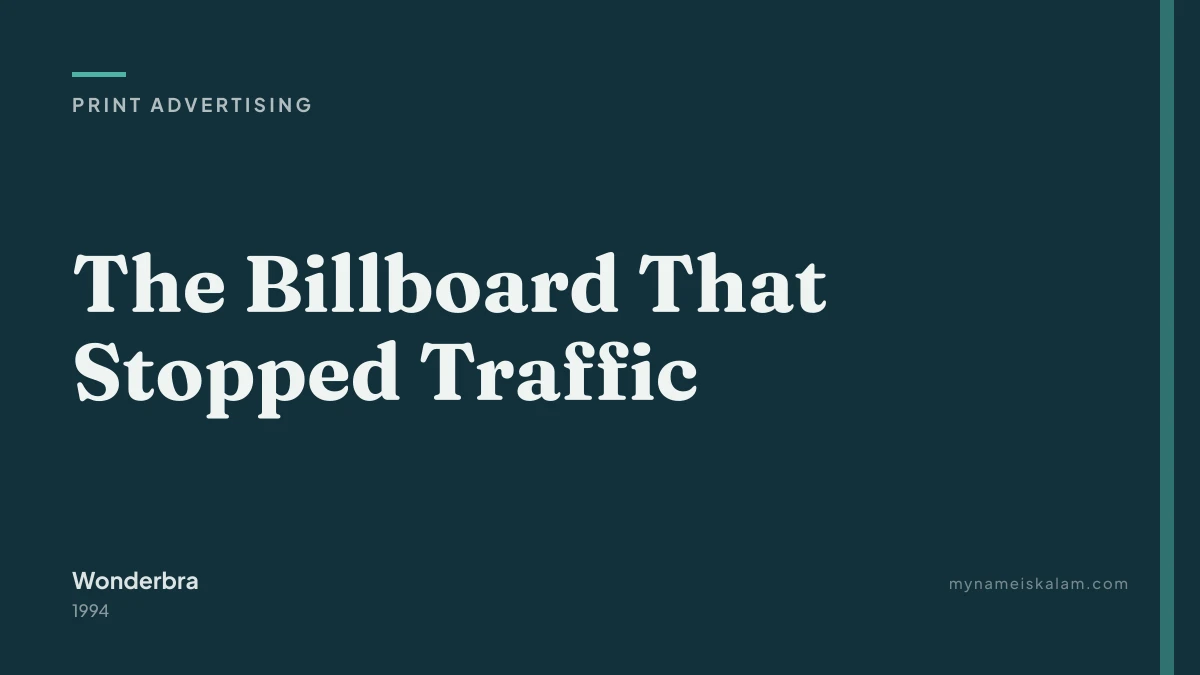
Somewhere in Britain in 1994, a man drove his car into something he shouldn’t have because he was looking at a billboard. The story was reported in newspapers across the country, and whether or not every incident was as dramatic as the tabloids made out, the point was made: Wonderbra’s “Hello Boys” campaign had entered the national conversation. You don’t get that from good media planning alone.
The campaign was simple in a way that advertising people spend careers trying to achieve. Model Eva Herzigová in a black Wonderbra, looking down, with the headline “Hello Boys.” That’s it. No product features. No tagline about fit or fabric or support. No soft focus. No romantic setting. Just a direct address, from the product’s perspective, to the people who would be affected by the product. The implication landed before most viewers had consciously processed the image.
The Context
Lingerie advertising in 1994 operated in a fairly narrow register. The dominant mode was aspirational and romantic: beautiful women in lovely settings, gentle lighting, the suggestion of intimacy without anything too direct. Brands like Victoria’s Secret in the United States and La Senza in the UK treated the category as fantasy. The woman in the ad was usually the aspirational figure, the person you wanted to be. The man, if present at all, was somewhere in the background of the implication.
What TBWA did with “Hello Boys” was different in several ways at once. First, it acknowledged men explicitly as an audience, which lingerie advertising almost never did in that era. The bra is speaking to men, not to women, which means the woman wearing it is in on a joke with the brand about the bra’s effect. Second, the tone was confident to the point of arrogance. “Hello Boys” isn’t a whisper or a suggestion. It’s an announcement. Third, the setting was a billboard, the most public of all advertising formats, which turned a category that lived in private spaces (bedrooms, changing rooms, the pages of catalogs) into something that occupied the street.
The choice of Herzigová was also important. She was 21, Czech-born, already working in the industry but not yet a household name outside of it. The campaign made her one. She’s been asked about “Hello Boys” in interviews for the thirty years since it ran, which is a measure of how completely the campaign defined a moment in British popular culture.
The Campaign
The outdoor execution was the campaign’s primary form. TBWA placed the ads across 800 billboard sites around the UK, which meant that in most major British cities, you couldn’t move through the commercial heart of the place without seeing Eva Herzigová looking down at you.
Newspaper advertising ran in parallel, maintaining the same visual and the same headline across different formats. But the billboards were the event. Outdoor advertising at that scale, with that image, in a country where public space felt more regulated and more restrained than, say, American advertising culture, was genuinely provocative in a structural sense. The ads were where you didn’t expect them to be aggressive.
The Advertising Standards Authority received complaints. Multiple newspapers ran stories about the billboard causing traffic disruptions. Politicians made comments. All of that coverage, none of it paid for, extended the campaign’s reach enormously. The earned media from the controversy was worth more than the placed media budget, almost certainly. Wonderbra and TBWA understood this, even if the original creative decision wasn’t made cynically with that calculation in mind.
Why It Worked
Two words: category contrast. Every category has a dominant visual and tonal language. Lingerie in the early 1990s was romanticized, soft, aspirational for women. “Hello Boys” was none of those things. It was direct, slightly irreverent, and addressed the wrong audience — or the right one, depending on your perspective.
When advertising breaks sharply from category norms, it’s noticed. That’s basic attention economics: we filter out the expected and register the unexpected. But contrast alone doesn’t make a campaign work. The contrasting choice also has to be true, in some meaningful sense, to what the product does. A push-up bra does attract attention from men. The campaign didn’t invent that fact; it just said it out loud in a place where everyone could hear.
The simplicity of the headline deserves its own consideration. Two words. Subject and object, depending on how you read them. No explanation of why, no apology, no softening clause. In copywriting terms, “Hello Boys” is a masterwork of compression. It says everything the campaign needs to say and nothing it doesn’t. Eva Herzigová’s expression completes it: she’s looking down with something between amusement and satisfaction, which is the correct emotion for someone who knows exactly what’s happening.
There’s also the matter of what the campaign communicated about the brand, separate from any product claim. Wonderbra was positioning itself as a brand that doesn’t take itself too seriously, that understands the fundamental situation it’s involved in, and that’s comfortable being frank about it. That’s a personality, and personality is what makes a brand something more than a functional choice.
The Results
Wonderbra’s UK sales increased substantially in the period following the campaign’s launch, and the brand consolidated its position as the market leader in the push-up bra category. The specifics of the sales figures were closely held, but the market position shift was documented by industry analysts and acknowledged in Wonderbra’s own subsequent communications.
More measurably, “Hello Boys” won creative awards across the advertising industry and has since been cited in virtually every serious survey of the most effective or most memorable British advertising of the 1990s. Herzigová’s face from the campaign appears in retrospectives of the decade regularly enough that it has become a kind of visual shorthand for 1990s Britain, its confidence, its humor, and its occasional disregard for what critics were starting to say about images of women in advertising.
The Lesson for Today’s Marketers
The honest lesson here is complicated, and it deserves to be treated as such rather than flattened into something comfortable.
“Hello Boys” worked. By any commercial measure, it worked spectacularly. It broke category conventions, generated enormous coverage, defined a brand’s personality, and drove sales. The craft was exceptional: two words, the right image, the right scale, the right placement.
It also would not be made today, not without significant argument, and possibly not at all. The advertising landscape has shifted in what it considers acceptable, and the direction of that shift reflects genuine changes in how we think about the representation of women in public space. That’s not a fashionable observation; it’s just true. What reads as bold confidence in 1994 reads somewhat differently in the context of debates that came later.
The practical lesson isn’t “be provocative.” It’s more specific: know what your category refuses to say out loud, and say it clearly, if you can do so with craft and without causing real harm. Wonderbra had a genuine insight (everyone knows what a push-up bra is for) and the confidence to articulate it directly. That confidence came from a product truth. The campaign didn’t claim something false; it just named something true that the category had been treating as unspeakable.
Finding your category’s unspeakable truth and speaking it is still excellent strategic territory. The judgment call is whether speaking it builds something real or just generates noise. In 1994, for Wonderbra, it built something real.
Key Results
- Billboard Sites: 800+ UK outdoor placements in the initial run
- Press Coverage: Reported on front pages of multiple national newspapers
- Market Result: Wonderbra became the dominant UK push-up bra brand within the campaign period
SWOT Analysis
| Strengths | Weaknesses | Opportunities | Threats |
|---|---|---|---|
|
|
|
|
Key Takeaway
The most effective advertising in a category often works by refusing every convention of that category — but the courage to do that requires a genuine point of view, not just a desire to shock.
Enjoying our content? Make us a preferred source on Google.
Add as Preferred Source