
Snickers "You're Not You When You're Hungry": How a Simple Insight Became a Global Platform
A 30-second Super Bowl ad featuring Betty White getting tackled in a football game launched a decade-long global platform that turned Snickers back into the world's best-selling candy bar.

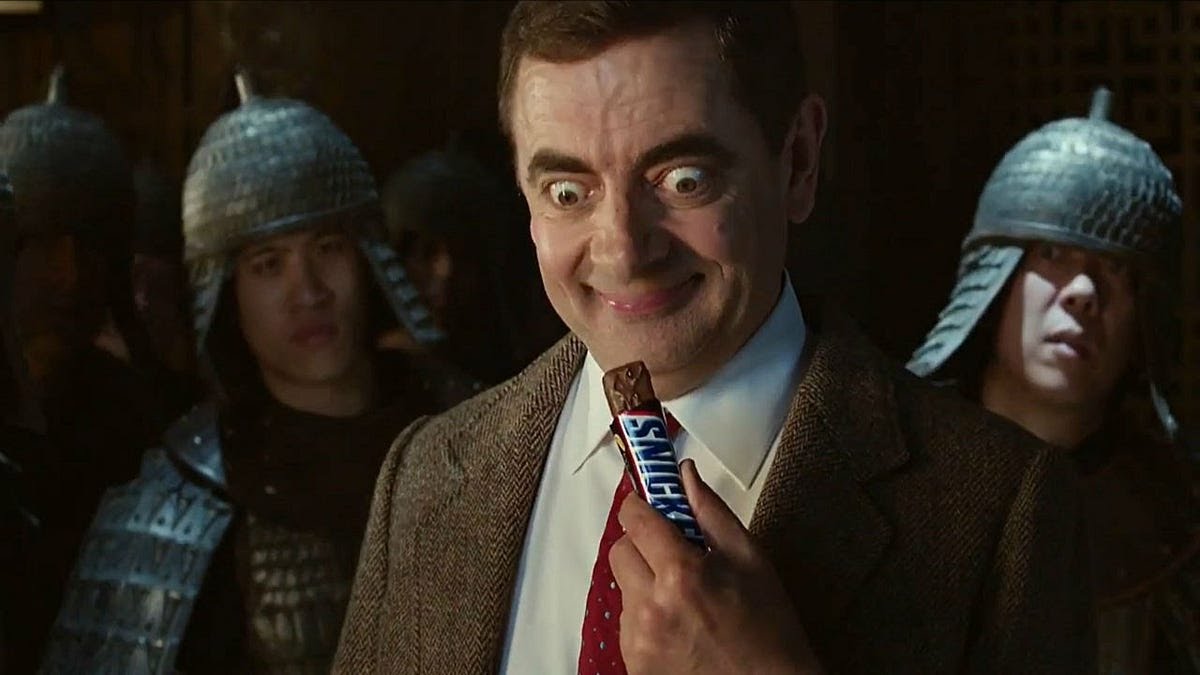
- Brand
- Snickers
- Year
- 2010
- Agency
- BBDO
- Industry
- Food & Beverage
There’s a moment in the 2010 Super Bowl ad where an 88-year-old Betty White gets absolutely flattened by a defensive tackle in a muddy backyard football game. She goes down hard. The other players look at her with a mixture of concern and mild irritation. “Mike, you’re playing like Betty White out there,” one of them says. And then a woman offers Betty a Snickers bar, she takes a bite, and suddenly she’s a young man again, bouncing back up, ready to keep playing.
That was it. That was the whole idea. BBDO had given Snickers one of the cleanest campaign platforms in the history of packaged goods advertising, and it would run, in one form or another, for the next decade-plus across more than 80 countries. It started with an 88-year-old woman in the mud, and it worked because the idea underneath it was completely, inescapably true.
The Context
By the late 2000s, Snickers had a product positioning problem that wasn’t really about the product. The bar itself was fine. Mars Inc.’s flagship candy was still one of the most-distributed confections in the world, with substantial brand awareness in every major market. But awareness and desirability are different things, and Snickers had drifted into a kind of generic confection territory, a thing you ate at a petrol station when nothing else was available, rather than the thing you specifically wanted.
BBDO New York had been working with Mars on Snickers for years, and the creative team went looking for an insight that could reframe the bar as genuinely useful rather than merely available. The functional answer was sitting there all along: Snickers satisfies hunger. That’s what the bar does. It’s calorie-dense, filling, and it takes the edge off. Everyone who has ever snapped at a colleague before lunch knows what the hunger-irritability connection feels like from the inside.
The insight, translated into a creative brief, was: when you’re hungry, you’re not yourself. You’re irritable, distracted, maybe irrational. Snickers fixes it. You become yourself again. Simple. Functional. And funnier than any candy bar had any right to be when executed properly.
The Campaign
The Betty White Super Bowl spot aired in February 2010 during Super Bowl XLIV, the same game where Old Spice launched “The Man Your Man Could Smell Like.” It was a good year for advertising, but Snickers arguably had the cleaner idea.
The casting choice for the launch execution was strategically loaded. Betty White was, in 2010, genuinely beloved but not especially current: an 88-year-old actress best known to most viewers as Rose Nylund from The Golden Girls. Putting her in a full-contact backyard football game was funny in layers: physically absurd, sweetly incongruous, and loaded with the particular affection Americans had for White specifically. The joke landed on the image and then again on the reveal. She bit the Snickers bar and became herself, which is to say a young man. The tagline read across the screen: “You’re not you when you’re hungry.”
The campaign scale that followed was remarkable. BBDO built the platform so that the template could be transferred to any culture with a recognizable personality. In the UK, it was Joan Collins. In Australia, it was local sports figures acting completely wrong for their context. In dozens of other markets, BBDO worked with local agencies to find the equivalent of Betty White: someone immediately recognizable, beloved, associated with a clear set of characteristics, so that seeing them behave out of character produced immediate cognitive dissonance and then relief when the Snickers fix arrived.
This wasn’t just dubbing an American ad with local accents. The platform was designed from the start to be localized at the execution level while being globally consistent at the insight level. The same human truth, the same product claim, different faces, different cultural context.
Why It Worked
The campaign’s durability came from the quality of the underlying insight, and it’s worth being precise about what made the insight strong.
“You’re not you when you’re hungry” works because it describes something that everyone has experienced but few have named. The pre-lunch irritability, the irrational argument at 4pm, the inability to focus before dinner: these are universal experiences that, once labeled, are immediately recognizable. The campaign gave people a frame for understanding their own behavior, which is a rare thing for advertising to achieve. Frames like that stick, and once a brand owns a frame, it’s very hard to dislodge.
The product benefit was central and undisguised. Unlike emotional campaigns that try to associate a brand with a feeling while keeping the product in the background, Snickers was upfront: we satisfy hunger. This is what we do. It’s a functional claim dressed in humor rather than delivered as a rational argument, which means it bypassed the resistance that explicit product claims usually generate while still registering the message.
Betty White’s specific effectiveness in the launch execution came from precision, not just novelty. The joke needed someone who embodied a very clear set of characteristics - sweetness, fragility, grandmotherly warmth - so that seeing her replaced by a 25-year-old male football player after eating Snickers registered as a satisfying restoration of order. A celebrity who was simply famous wouldn’t have worked. The gap between “who this person is” and “what we’re showing them doing” had to be wide and instantly legible.
The Results
By 2014, Snickers had reclaimed its position as the best-selling candy bar in the world. The campaign had been running consistently across markets for four years by that point, with no sign of exhaustion. The Mars organization continued to extend the platform through the late 2010s, adding executions involving social media, real-time advertising (a 2016 UK campaign served different versions of the ad based on what people were searching), and limited-edition packaging.
The Betty White spot directly contributed to a late-career resurgence for White herself, who went on to host Saturday Night Live in 2010 following a campaign by fans after the commercial aired. She remained in public life and continued working until her death at age 99 in December 2021. The Snickers ad is regularly cited as the moment her cultural relevance was renewed.
Industry recognition was consistent throughout the campaign’s run. Multiple Cannes Lions, repeated Effie Awards recognizing commercial effectiveness, and a consistent presence in global rankings of most effective long-running campaigns followed the platform wherever it went.
The Lesson for Today’s Marketers
There’s a tendency in contemporary marketing to reach for purpose, meaning, social relevance, or emotional abstraction when a brief is hard to crack. The assumption is that functional benefits are unsexy, that saying “our product does X” isn’t compelling enough for modern audiences who want brands to stand for something larger.
Snickers’ campaign is a direct rebuttal to that assumption.
“You’re not you when you’re hungry” is a functional insight. Snickers satisfies hunger. That’s the message. The campaign doesn’t ask you to admire Snickers for its values, or to feel that Snickers understands your emotional journey. It says: you feel bad, eat this, you’ll feel better. The humor is the vehicle, not the destination.
Campaigns built on real product truths outlast emotionally abstract alternatives for a simple reason: the product truth doesn’t age. Every new person who has ever been irritable before lunch is a new convert to the insight. The humor refreshes the delivery. The truth underneath it doesn’t need refreshing because it’s still true.
Find the real thing your product does, the thing that is genuinely, functionally valuable to the person using it, and find a way to express that truth that’s more entertaining than anyone expects. That’s not a formula. But the Snickers case is as close to a proof of concept as the industry has produced.
Key results
By 2014, Snickers had reclaimed its position as the best-selling candy bar in the world
The platform ran continuously for over a decade across dozens of markets, one of the longest-running consistent campaign platforms in FMCG
The campaign was adapted into localized versions across more than 80 countries, with local celebrities acting out of character in each market
Betty White's appearance became one of the most discussed Super Bowl commercials of 2010; the spot contributed to a resurgence in her career that lasted until her death in 2021
Won multiple Cannes Lions and Effie Awards; consistently ranked among the most effective long-running FMCG campaigns in Effie global rankings
SWOT analysis
S Strengths
- The insight was grounded in a genuine human truth (hunger does make people irritable and unlike themselves), making the premise universally relatable
- The campaign delivered a clear product benefit (Snickers satisfies hunger) through entertainment rather than claim, which audiences accepted without resistance
- The platform was infinitely scalable: any person known for one thing acting completely unlike themselves works as an execution
- Betty White's casting for the launch spot was perfect: an 88-year-old woman getting tackled playing football was visually arresting and generated enormous goodwill
W Weaknesses
- The campaign's dependence on celebrity recognition meant each execution required talent procurement, which added cost and complexity
- After a decade, the 'out of character' format became so well-known that each new execution was compared against a well-established template rather than evaluated fresh
O Opportunities
- The global adaptation model created genuine local relevance without abandoning the platform, making it more effective than a centrally-produced one-size campaign
- The campaign provided a durable mental model: when people felt irritable, they had been given a framework to explain it (hunger) and a solution (Snickers)
T Threats
- Competitors could attempt to imitate the insight-led humor format, though none found a platform as durable
- Over-reliance on the platform created a risk: if public sentiment around any individual celebrity soured, the brand association could be damaged by association
A campaign built on a real functional insight, dressed in humor, will outlast almost any purpose-driven or emotionally abstract alternative, because it gives people both a reason to watch and a reason to buy.
Frameworks at play
AIDA Marketing Model (AIDA)
The oldest persuasion framework in modern marketing. AIDA maps the mental states a buyer passes through before they act, and it still explains why most great ads work.
Read the AIDA → Strategy · Customer ResearchJobs to Be Done (JTBD)
A framework that reframes the question of why customers buy by focusing on the underlying job they're trying to get done - not the product they choose to do it.
Read the JTBD →Sources & references
Want help with this for your brand? See my services.
Enjoying our content? Make us a preferred source on Google.
Add as Preferred Source