Pepsi Kendall Jenner Ad: A Marketing Failure Case Study
Pepsi's Kendall Jenner ad was pulled within 24 hours — a case study in how purpose-washing fails when there's no genuine connection between a brand and the cause it's appropriating.
On April 4, 2017, Pepsi released a two-and-a-half-minute commercial starring Kendall Jenner. By April 5, it was gone, pulled from every platform with a corporate apology. It remains one of the most complete and rapid brand retreats in modern advertising history, and one of the most instructive case studies in the specific failure mode known as purpose-washing.
The Context
The commercial was produced entirely by Pepsi’s Creators League Studio: an in-house content production team established to give the company greater creative control and faster production turnaround than working with external agencies allows. There was no external agency involved in the concept development, production, or review process.
The ad was produced and released in a period of acute public sensitivity around protest, racial justice, and police-civilian relations. The Black Lives Matter movement had been a consistent presence in American media and public life since 2013. The Women’s March in January 2017 had produced one of the largest single-day demonstrations in American history. Protest imagery was not abstract; it was immediate, politically charged, and deeply personal to a large portion of the population.
These weren’t obscure background facts. They were front-page news continuously in the weeks before the ad’s release.
The Campaign
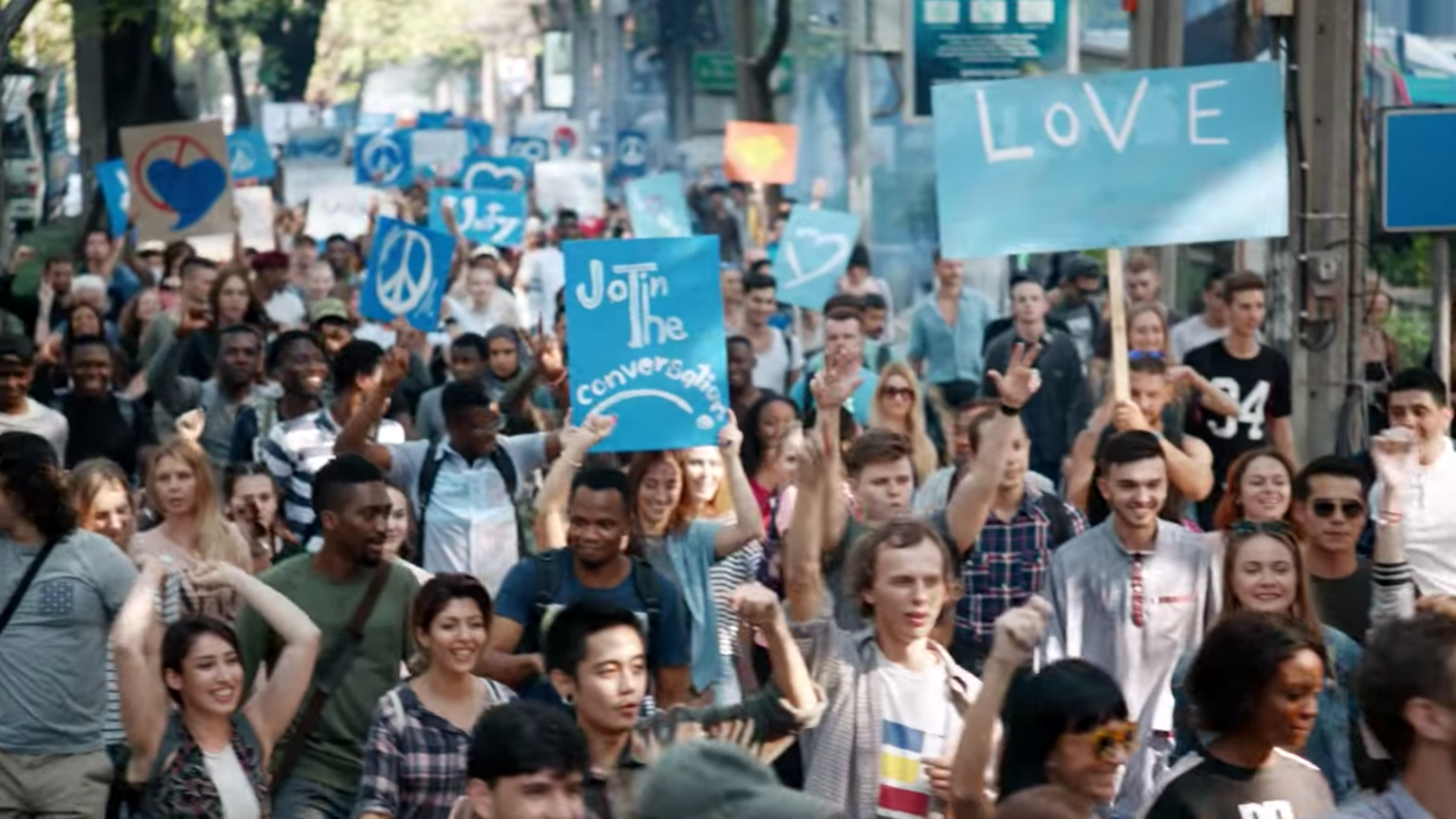
The commercial opens on Jenner in the middle of a high-fashion photo shoot, blonde wig and dramatic makeup. Outside, a diverse and photogenic crowd of young people walks past carrying protest signs. The signs say things like “Join the Conversation.” There is no identifiable cause.
Jenner notices the march, is moved by it, strips off her wig (handing it to a Black woman standing nearby), wipes off her lipstick, and joins the protest in her street clothes. The crowd advances toward a line of police officers in full gear. The atmosphere builds. Jenner walks to the front of the crowd, takes a can of Pepsi, walks up to a police officer, and hands it to him. He opens the can. He takes a sip. He smiles. The crowd cheers. The music swells. Everyone is joyful.
The ad’s intended message (that Pepsi brings people together, that unity transcends conflict) was not difficult to understand. It was the reading of that message in cultural context that the creative team failed to anticipate.
Why It Failed
The imagery in the ad was read immediately and nearly universally as a reference to real protest footage, specifically the widely circulated photograph of Ieshia Evans, a Black woman standing alone in front of a line of riot police during a Baton Rouge protest in July 2016. Evans was arrested. The photograph had become iconic.
The ad recreated the visual grammar of that image and resolved it with a white celebrity handing a soda to a police officer, followed by universal joy. For people who had watched Evans’s arrest, or who had participated in or known people affected by the protests the imagery referenced, this was not a message of unity. It was a message that the entire edifice of structural conflict (the protests, the underlying grievances, the real and documented danger that protesters faced) could be dissolved by the right commercial product in the right celebrity’s hands.
Bernice King, daughter of Martin Luther King Jr., tweeted within hours: “If only Daddy would have known about the power of #Pepsi.” The tweet was retweeted hundreds of thousands of times. It crystallized what was wrong with the ad in a single sentence, and it did so from a source whose authority on the subject was impossible to dismiss.
The structural problem beneath the creative problem was the absence of external review. The Creators League Studio team worked in an environment where everyone shared approximately the same cultural vantage point. Nobody in the review chain had the outsider perspective to see how the imagery would land for people outside that building. An external agency, particularly one with meaningful diversity, almost certainly would have flagged this before the ad was released. That review didn’t happen.
The specific choice of Kendall Jenner compounded the problem. Jenner is white, blonde, globally famous, and extremely wealthy, precisely the kind of person who can dip into protest culture, have a meaningful moment, and walk away without consequence. For actual protest participants, the ability to walk away is not a given. The casting made that contrast impossible to ignore.
The Results
Pepsi pulled the ad and issued an apology on April 5, within 24 hours of the commercial’s release. The statement read: “Pepsi was trying to project a global message of unity, peace and understanding. Clearly we missed the mark, and we apologize. We did not intend to make light of any serious issue. We are removing the content and halting any further rollout.”
The apology acknowledged the failure without explaining its cause. There was no public discussion of how the ad had been reviewed or what processes had failed. Kendall Jenner addressed the incident publicly in a later season of Keeping Up with the Kardashians, visibly emotional during the discussion, a moment that itself became the subject of additional commentary about whose response to the failure was most visible.
The ad generated no measurable positive commercial outcomes and produced sustained negative press coverage across the rest of 2017. It was regularly cited as an example of corporate tone-deafness in marketing industry discussions throughout the year and continues to appear as a case study in purpose-washing failure.
The Lesson for Today’s Marketers
The Pepsi Kendall Jenner ad failed for a reason that’s more specific and more structural than “they were tone-deaf.” That’s the typical diagnosis, but it’s not the full one.
It failed because the creative team couldn’t see the gap between their intention (“unity”) and the cultural meaning of the imagery they selected. That gap wasn’t visible from inside the building. It required an outside perspective, someone who had a different relationship to the protest imagery, to see it. That perspective was structurally absent from the production process because there was no external agency involved.
The lesson isn’t that in-house production is inherently dangerous. It’s that the function an external agency serves isn’t just creative production. It’s the provision of a perspective that is not your own. When you remove that function, you need to replace it with something else: a diverse internal review group, external cultural consultants, a structured process for stress-testing creative work against audiences who don’t share your assumptions.
The ad that only people inside your building have reviewed hasn’t been reviewed. It’s been approved.
Key Results
- Campaign Duration: Released April 4, 2017; pulled April 5, 2017 — one of the fastest brand retreats in modern advertising history
- Social Backlash: The ad generated widespread viral criticism; Bernice King, daughter of Martin Luther King Jr., tweeted directly about it within hours of release
- Financial Impact: Production cost of the full-length ad was not disclosed; the reputational cost in press coverage and consumer trust damage significantly outweighed any creative investment
- Press Coverage: Covered as a news story by major international media outlets, generating widespread negative brand association for months after the pull
- Brand Response: Pepsi issued a formal apology statement: 'Clearly we missed the mark, and we apologize'
SWOT Analysis
| Strengths | Weaknesses | Opportunities | Threats |
|---|---|---|---|
|
|
|
|
Key Takeaway
No external agency review is not a cost-saving measure — it's the removal of the mechanism by which a brand discovers what its campaign actually communicates to people who don't work at the brand.