Nike Air Jordan: How a Rookie Deal Built a Multibillion-Dollar Brand Within a Brand
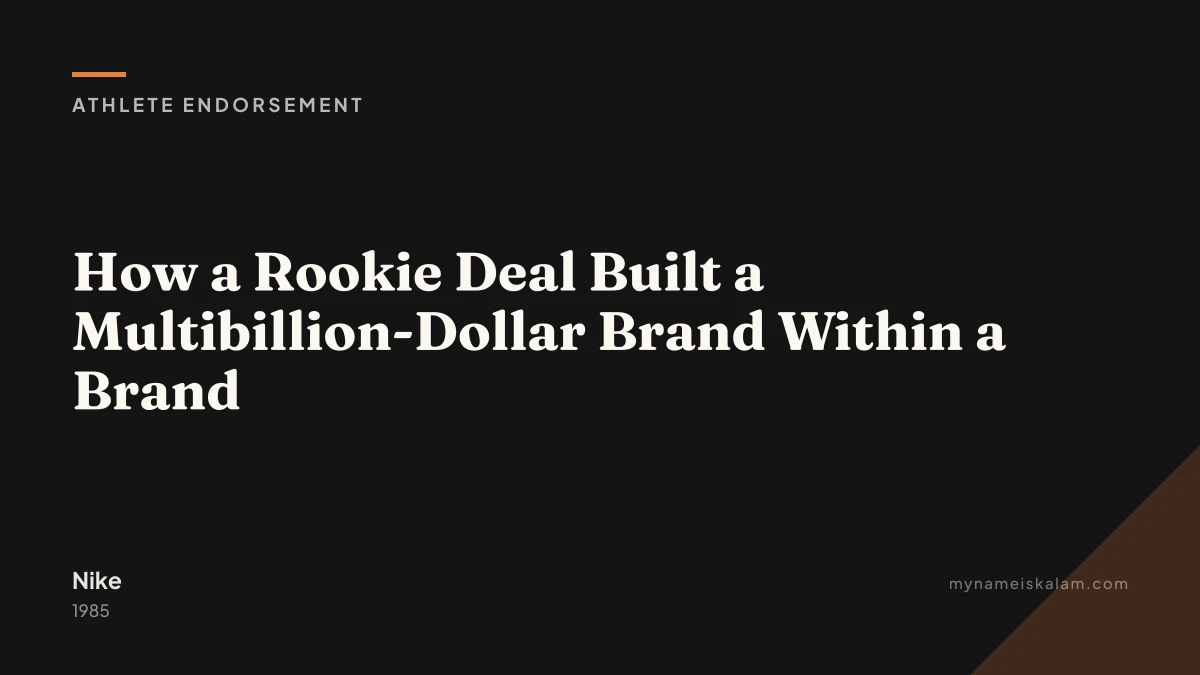
In 1984 Nike was a running company losing ground to Reebok, and Michael Jordan wanted to sign with Adidas. Nike bet its basketball budget on one rookie, gave him his own shoe, and turned a controversy over its colours into the launch campaign.
In 1984, the most valuable relationship in the history of sportswear started with a player who did not want to be in the room.
Michael Jordan, just drafted third overall by the Chicago Bulls, wanted to sign with Adidas. He had worn Converse at the University of North Carolina. Nike was a running company with little standing in basketball, and it was losing ground to Reebok. By most accounts, his parents had to persuade him to take the meeting in Oregon.
What Nike offered in that meeting was not just money. It was his own shoe, his own name on it, and a share of every pair sold. That offer created Air Jordan, and eventually Jordan Brand.
The Context
Nike’s position in 1984 was uncomfortable. The running boom that built the company had cooled. Reebok had taken the lead in the US market by moving early on aerobics. Nike had basketball endorsement deals with a number of NBA players, but no one who made the brand feel essential on court. Converse owned the league’s most famous players, and Adidas was the preferred brand for many young stars.
The prevailing model in basketball was to sign many players to modest deals and spread the brand across the league. Nike’s basketball team, led by executive Rob Strasser with talent scout Sonny Vaccaro pushing hard for Jordan, argued for the opposite: put most of the basketball budget on one player and build everything around him.
It was a risky bet. Jordan had not played a professional game. But Vaccaro and others believed his athleticism, his college profile and his personality made him the right person to carry a brand.
The Campaign
The deal Nike offered was reported at around $2.5 million over five years, an unusually large sum for a rookie then. More important in the long run was the structure: Jordan received a royalty on sales of his signature products. His success and Nike’s were tied together from the start.
The product was the Air Jordan 1, designed by Peter Moore, who also created the “Wings” logo. It was released to the public in the spring of 1985 at $65, a premium price for a basketball shoe at the time. The red, black and white colourway matched the Bulls’ uniform and was very different from the white shoes that dominated the league.
That colour became the launch story. The NBA had rules about uniform consistency, and the league sent Nike a letter objecting to shoes Jordan wore on court. Nike turned the objection into an ad. A television spot pans slowly down Jordan’s body as the narrator says that on September 15 Nike created a revolutionary new basketball shoe, and on October 18 the NBA threw them out of the game. The screen then blacks out the shoes: “Fortunately, the NBA can’t stop you from wearing them.”
The “banned” story is simplified. Later reporting suggests the shoe the league actually objected to was an earlier Nike model, the Air Ship, not the Air Jordan 1. But the effect on consumers was the same. A shoe the league did not want you to see was one teenagers wanted to own.
The advertising was supported by Jordan’s performance. He won Rookie of the Year in the 1984–85 season and played in a style that looked extraordinary on television. From 1988, Spike Lee’s Mars Blackmon ads with Jordan, created by Wieden+Kennedy, gave the line a comic, pop-culture voice.
Why It Worked
Nike concentrated the bet. Instead of a dozen modest endorsements, Nike put its basketball future on one person. That meant every ad, every product and every retail display had the same face. The brand was unmistakable.
The athlete became the product. Before Air Jordan, endorsements mostly meant a player wore a brand’s shoe. Nike made the player the name of the shoe. That gave consumers a way to own a piece of Jordan that no other brand could sell.
The incentives were aligned. The royalty gave Jordan a financial reason to care about the line’s success and to stay with Nike. Many signature deals across sport now follow a similar model.
Controversy made it desirable. The “banned” framing turned a regulatory nuisance into the shoe’s most memorable story. It positioned the Air Jordan as rebellious at exactly the moment basketball shoes were becoming street fashion.
The athlete delivered. None of this works if Jordan is an average player. He became the most famous athlete in the world, and every championship renewed the brand.
The Results
Nike had modest internal expectations for the line. Air Jordan sales in the first year are widely reported at around $126 million. The shoe became one of the most successful product launches in sportswear history and helped lift Nike’s basketball business at a time when the rest of the company was under pressure.
The line survived early setbacks, including Jordan’s broken foot in his second season and a period of tension over the shoe’s design direction, which led Tinker Hatfield to take over design from the Air Jordan 3 onward. By 1997 Jordan had become its own brand within Nike, with its own logo, the Jumpman.
Decades after Jordan’s last game, the brand is larger than ever. Nike reported Jordan Brand revenue of more than $6.5 billion in fiscal 2023. The story was retold in the 2023 film Air, directed by Ben Affleck, which brought renewed attention to how close the deal came to not happening.
The Lesson for Today’s Marketers
Spreading a budget thinly across many partners feels safe, but it rarely builds anything distinctive. Nike’s decision to concentrate on one person is the reason the brand became unmistakable.
The deeper lesson is about structure. Nike did not rent Jordan’s image; it built a product line around him and gave him a stake in it. When partners share in the upside, they behave like owners, and the relationship lasts.
Finally, a constraint can be a story. The NBA’s objection could have been a problem to manage quietly. Nike made it the ad.
Key Results
- First-year sales: Air Jordan sales are widely reported at about $126 million in the first year, against internal hopes of a few million dollars over several years
- Launch price: The Air Jordan 1 retailed at $65 in 1985, a premium price for a basketball shoe at the time
- Brand today: Nike reported Jordan Brand revenue of more than $6.5 billion in fiscal 2023
- Endorsement model: The deal gave Jordan a royalty on sales, a structure that became the template for signature-athlete deals across the industry
SWOT Analysis
| Strengths | Weaknesses | Opportunities | Threats |
|---|---|---|---|
|
|
|
|
Key Takeaway
Nike did not sponsor an athlete; it built a product line around one and gave him a stake in its success. Concentrating the bet on a single, highly visible person turned a shoe into a brand that is now bigger than most standalone sportswear companies.
Enjoying our content? Make us a preferred source on Google.
Add as Preferred Source