
Cosmopolitan Yogurt: The Magazine That Couldn't Sell Dairy Products
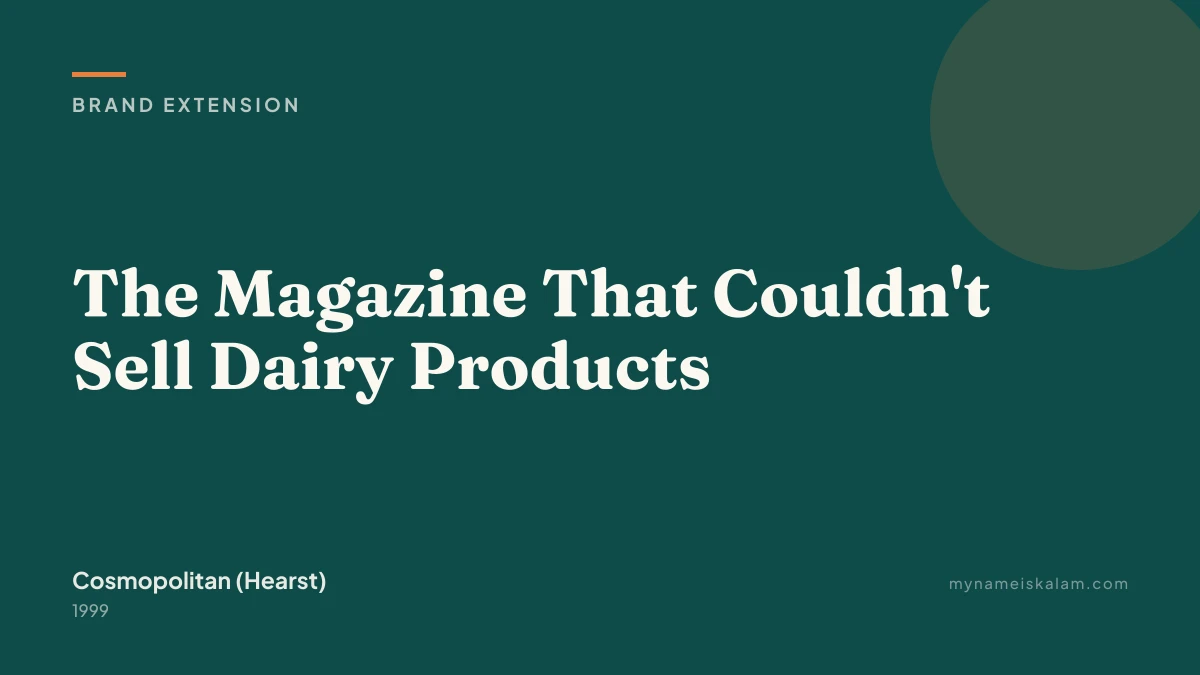
Cosmopolitan magazine launched a line of yogurt in 1999 and discovered that brand equity built on glamour and confidence has nowhere to go in the dairy aisle.

- Brand
- Cosmopolitan (Hearst)
- Year
- 1999
- Industry
- Food & Beverage, Publishing
Imagine you’re standing in a supermarket dairy aisle in 1999. You reach for yogurt. What are you thinking about? Probably: what flavor do I want, what’s on sale, do I have enough at home already. You are almost certainly not thinking about female confidence, sexual empowerment, or magazine-quality style. You are thinking about yogurt.
This is the problem Cosmopolitan walked into when it launched a branded yogurt line in the United Kingdom in 1999. The brand was powerful. The product category had nothing to do with the brand. The distance between those two facts proved insurmountable, and the product disappeared quietly, as most failed brand extensions do, without much ceremony.
The story is almost too clean in its illustration of what brand extension failure looks like at the conceptual level. Which is exactly why it’s worth telling carefully.
The Context
By the late 1990s, Cosmopolitan was one of the world’s most successful magazine brands. Founded in the United States and relaunched under Helen Gurley Brown in 1965, it had expanded to dozens of international editions and built an identity that was specific and potent: Cosmo was about female confidence, sexuality, career ambition, and a particular kind of unapologetic engagement with pleasure and style. The brand’s equity was emotional rather than functional. Readers didn’t buy Cosmo for information they couldn’t get elsewhere. They bought it because the brand made them feel something, engaged, included in a certain kind of modern femininity, entertained.
Hearst, Cosmo’s publisher, had watched other media brands extend into consumer products with varying success. Martha Stewart Living had built an enormous licensing and products empire by this point, expanding from magazine into housewares, gardening, food products, and television. The logic of extending a lifestyle brand into consumer goods was well established.
The error was in thinking that Cosmo’s situation resembled Martha Stewart’s. Martha Stewart’s brand equity is specifically about domestic excellence and expertise: the home, food, crafts, entertaining. Every product that carries the Martha Stewart name exists inside the territory her brand has always owned. The brand makes those products better because consumers believe Martha Stewart knows exactly what a good dish towel or a well-designed holiday ornament looks like.
Cosmopolitan’s equity is about something else entirely. Cosmo is about female confidence and a certain glamorous approach to life. Those are real values that matter to real people. They just have no pathway into the yogurt category.
The Campaign
The Cosmo yogurt line launched in UK supermarkets with packaging that carried the magazine’s visual identity: the bold Cosmopolitan logo, color treatments consistent with the magazine’s aesthetic, the general suggestion that this was a product for modern, confident women. The positioning was never entirely clear. It wasn’t specifically a diet product, nor was it a premium indulgence product, nor was it functionally differentiated in any way that dairy companies typically use to justify premium pricing (probiotic cultures, exotic flavors, unusual textures).
It was, essentially, yogurt. With the Cosmo name on it.
The fundamental question the marketing had to answer but couldn’t: why should a woman buying yogurt choose this one? What does the Cosmo name do for this product? The brand’s emotional territory, confidence, sexuality, glamour, doesn’t translate into a reason to prefer one yogurt over another. Yogurt doesn’t become sexier or more confident because of the logo on the lid. The product experience is identical whether it’s branded Cosmo or Müller or Danone. The brand offered no reason to switch.
This distinguishes Cosmo yogurt from brand extensions that work. Harley-Davidson sunglasses make sense because both the motorcycle and the sunglasses participate in the same masculine, outdoor, freedom-oriented lifestyle. The brand adds something to the product because the product genuinely lives in the brand’s world. A Harley rider wearing Harley sunglasses is being coherent about who they are. A modern woman buying Cosmo yogurt over any other yogurt is just… buying yogurt.
Why It Failed
The brand extension literature has a useful test: does the brand’s core equity directly improve the product experience in the new category? For a cosmetics brand extending into skincare, the answer is yes, because beauty expertise transfers. For a sports brand extending into performance apparel, yes, because athletic credibility transfers. For a magazine built on editorial authority about female lifestyle extending into dairy products, the answer is a clear no.
Cosmo could tell you how to dress for a first date. It could recommend the right red lipstick. It could give you advice about your career and your relationships. None of those capabilities had any relevance in the yogurt aisle. The brand’s authority existed in a specific domain, editorial guidance about modern femininity, and that domain didn’t include food manufacturing, flavor development, dairy quality, or nutritional expertise.
The comparison that makes this vivid: imagine a reader picking up a Cosmo and reading an article about the best yogurts of 1999, comparing taste, texture, and value. That content would fit naturally in the magazine. Now imagine that reader buying the Cosmo-branded yogurt off a supermarket shelf. In the first case, the brand is doing what it does, providing trustworthy editorial judgment about things that matter to its audience. In the second case, the brand is trying to make money off its name in a context where its editorial credibility is irrelevant.
There was also a retail problem. Supermarket buyers make stocking decisions based on category performance data. A yogurt product, regardless of its brand name, has to compete on the terms of the yogurt category: price, flavor range, shelf life, and whether consumers will repurchase. A first purchase driven by brand curiosity is not enough to sustain a product in a habitual, low-involvement category. And in yogurt, habit is everything. People find a yogurt they like and they buy it every week without thinking. Cosmo had no mechanism to interrupt that habit in a sustained way.
The Results
The product was discontinued, most sources suggest within roughly 18 months of launch. There were no dramatic headlines about the failure. It was the kind of quiet withdrawal that happens when a product simply doesn’t generate enough consumer demand to justify its shelf space. Hearst moved on. Cosmopolitan continued as a magazine, and the yogurt experiment became a minor footnote in brand extension case studies.
What the failure didn’t do was permanently damage the Cosmo brand. Magazine readers kept reading. The equity that lived in the editorial product, the confidence and style identity, remained intact because readers never really connected it to the yogurt in the first place. When a brand extension fails this cleanly, the main brand often survives unscathed. This is a different outcome than the Harley-Davidson licensing situation, where the sheer volume of incoherent extensions created real dilution.
The lesson from Cosmo is about the asymmetry of brand extension risk: the upside is modest (some incremental revenue if the product finds its footing), while the downside is wasted capital, management attention, and a mild reputational bruise that comes from being associated with a product that didn’t work.
The Lesson for Today’s Marketers
The brand extension test that Cosmo yogurt failed is worth articulating precisely: your brand equity should be a specific advantage in the new category, not just a name recognition boost. Name recognition gets a consumer to pick up the product once. Genuine brand advantage, credibility, expertise, aesthetic alignment, community belonging, gets them to come back.
Media companies in particular have faced this question repeatedly as they’ve tried to expand from content into physical products. The ones that work (Bon Appétit’s recipe tools, certain food magazines’ cookware lines) work because the editorial authority of the brand transfers directly into the product category. The ones that fail do so because the brand’s authority lives somewhere else.
Before extending, ask the honest version of the question: not “will our fans recognize this product?” but “does our brand make this product genuinely better for the consumer?” If you can’t answer that question with a specific mechanism, not just a feeling but a real reason the brand improves the product experience, you’re probably about to launch a Cosmo yogurt. And the market is generally indifferent to yogurt that’s just yogurt with a famous name on top.
Key results
United Kingdom
Quietly discontinued within approximately 18 months
Product withdrawn; no further food extension attempts
SWOT analysis
S Strengths
- Cosmopolitan had one of the most recognized magazine brands globally among its target demographic
- Strong emotional connection with female readers aged 18–35
- Hearst had capital and distribution relationships to bring the product to market
W Weaknesses
- Brand equity had no relevance to the yogurt category or purchase decision
- Yogurt is a commodity bought on habit and price, not aspiration
- No product differentiation beyond the brand name on the packaging
O Opportunities
- Female consumers in the UK represented a large yogurt purchasing segment
- Lifestyle brand extensions in food were gaining traction in other categories
- Potential to create premium, beauty-adjacent positioning (probiotics, skin health)
T Threats
- Entrenched yogurt brands with established taste credentials and consumer habit
- Retail buyers skeptical of brand extension plays without category expertise
- Media ridicule risk if the product failed publicly
Your brand's equity only transfers when it genuinely improves the product experience in the new category. Cosmo's glamour had no mechanism to make yogurt better.
Want help with this for your brand? See my services.
Enjoying our content? Make us a preferred source on Google.
Add as Preferred Source