
Cadbury's Gorilla: The Ad That Had Nothing to Do With Chocolate
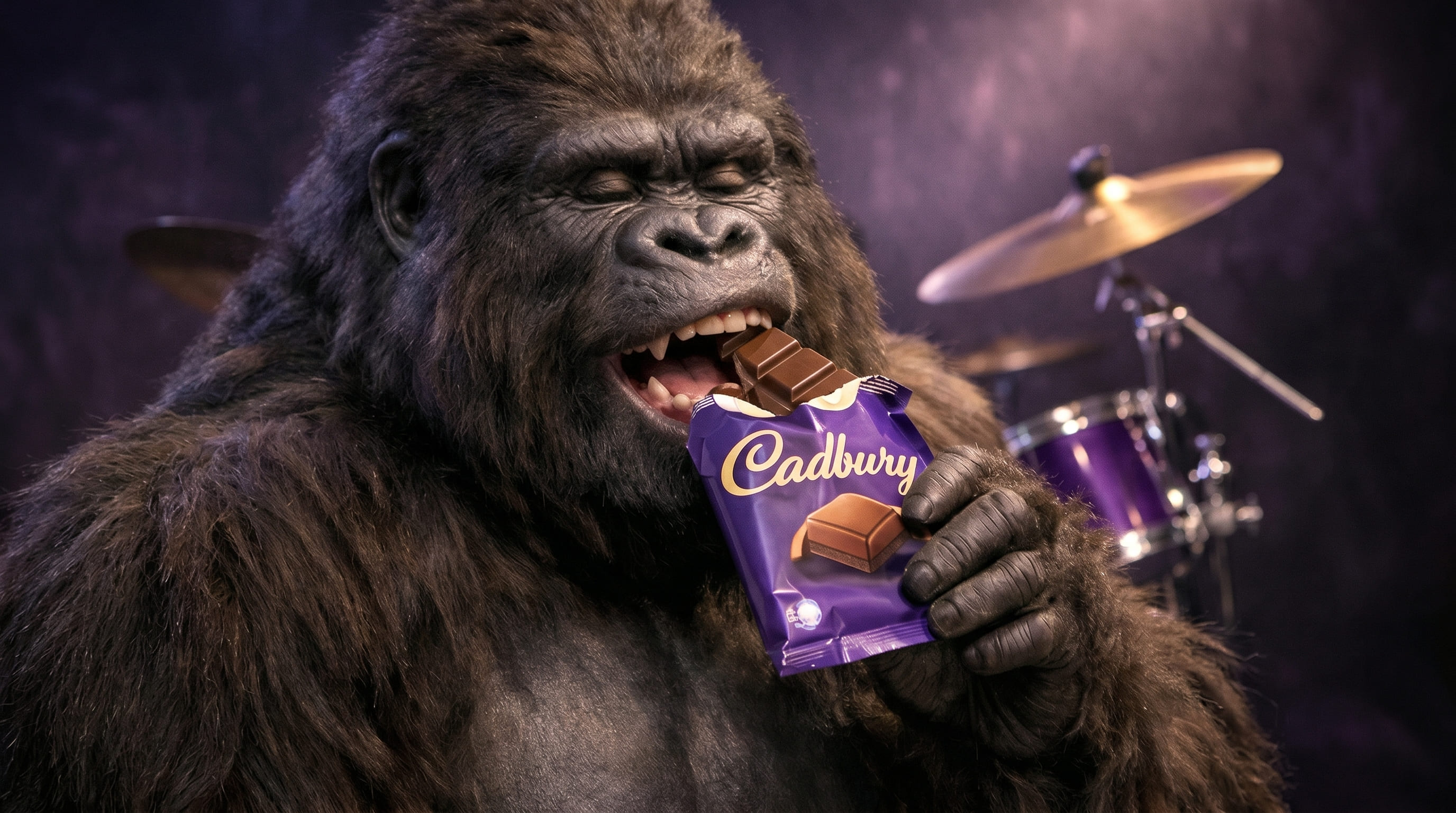
Fallon London rebuilt Cadbury's battered brand after a salmonella crisis by airing a gorilla playing Phil Collins on a drum kit - and never showing chocolate until the final seconds.

- Brand
- Cadbury
- Year
- 2007
- Agency
- Fallon London
- Industry
- Food & Beverage
In 2007, Fallon London aired a 90-second television commercial for a chocolate bar that contained no chocolate. There was no product shot until the final two seconds, no voiceover explaining the taste or ingredients, no celebrity endorsement, and no demonstration of any kind. There was a gorilla sitting at a drum kit in a dark arena, apparently waiting for something, and then the opening bars of Phil Collins’ “In the Air Tonight” began to play.
If you know the song, you know the drum fill that comes two-thirds of the way through. The gorilla knew it too. What followed was one of the most discussed pieces of advertising of the decade, and one of the clearest demonstrations on record of what “brand feeling” actually means as a marketing objective.
The Context
To understand why Fallon took such an unusual risk, you have to understand where Cadbury was in early 2007. The company had spent much of 2006 managing the fallout from a contamination incident: a salmonella outbreak traced to a Cadbury factory in Marlbrook had led to the recall of over a million chocolate bars. The Food Standards Agency investigation dragged on publicly. News coverage was extensive and damaging.
Cadbury’s brand health metrics had declined significantly. The damage wasn’t primarily rational (people knew, logically, that contamination crises are rare and correctable), but emotional. The name “Cadbury” now arrived with a slight trace of unease. The brand that had been associated with generosity, warmth, and childhood pleasure had acquired a different set of associations.
Cadbury asked Fallon London to help rebuild brand feeling. The brief, stripped to its core, was about joy: how do you remind people that Cadbury is a source of pleasure when the recent association has been the opposite? The creative director Juan Cabral’s answer was, by any conventional measure, absurd. A gorilla. Phil Collins. A drum fill. “A glass and a half full of joy.”
The Campaign
The ad opens on the gorilla seated behind a drum kit in what appears to be a large, empty arena. The lighting is low. The gorilla is breathing, clearly present, clearly waiting. There’s no product. There’s no logo. There’s no context. Just an animal at an instrument.
“In the Air Tonight” builds slowly, as the song always does. The gorilla’s hands begin to move, feeling the rhythm, not yet playing. And then the drum fill hits, and the gorilla attacks it with complete commitment, head rolling back, sticks flying, absolutely locked in. The camera cuts, pulls back, captures the performance. Two seconds before the end, a voiceover says “a glass and a half full of joy” and the Cadbury logo appears.
That’s it.
The ad aired in August 2007 during the Celebrity Big Brother finale in the UK, which meant it reached a large, entertainment-primed audience on first broadcast. The response was immediate and confounded people who expected advertising to make sense in a conventional way. Viewers rang radio stations to discuss it. It was talked about on breakfast television. Within weeks, the ad had spread online through email and early social sharing (YouTube was barely two years old; the concept of “viral video” was still new enough to be treated as a news story when it happened).
The gorilla, it turned out, was an actor in a suit. The suit cost around £10,000. The performance was Phil Collins himself on the original recording. The magic was in the decision to treat the whole thing with complete seriousness, to give a gorilla a real drum kit in a real location and film it as if it mattered.
Why It Worked
The ad was working on a level that product advertising almost never reaches, which is why it’s worth examining carefully.
Cadbury’s problem after the salmonella crisis wasn’t that people had forgotten what the product tasted like. It was that the brand’s emotional charge had shifted. Brand associations are not arguments; you can’t rebut them with better information. What you can do is replace them with something stronger. That requires making people feel something, and making them feel something different from what they’ve been feeling.
The gorilla ad generated joy. Not the polite, mild pleasantness of most advertising, but actual, unusual, slightly bewildered joy. The combination of the song (which carries enormous emotional freight for anyone who grew up with it), the gorilla’s total commitment to the performance, and the sheer strangeness of the whole thing created a response that was difficult to articulate but easy to feel. And feeling it was associated, via the logo and the tagline, with Cadbury.
This is what “brand feeling” means as a marketing objective, and it’s distinct from both “brand awareness” (do people know you exist?) and “purchase intent” (are people planning to buy you?). Brand feeling asks: what do people feel when they think about you? For Cadbury, the answer needed to shift from unease to pleasure, and a gorilla playing Phil Collins did it faster than any corrective messaging campaign could have.
There’s also a subtler reason the ad worked: it was easy to share and discuss because it was genuinely puzzling. “What was that gorilla thing?” was a conversation starter. It demanded an explanation that the explainer couldn’t fully give, which meant the ad kept circulating through social word-of-mouth in a way that a clean, legible commercial never would have.
The Results
Sales of Cadbury Dairy Milk rose by roughly 9% in the months following the campaign. More significantly, Cadbury’s brand health scores recovered to pre-crisis levels. The association with joy was restored. Given that the contamination story had been running for over a year at that point, the speed of the recovery was notable.
The ad won the IPA Effectiveness Grand Prix, which requires rigorous demonstration of commercial results, not just creative acclaim. It also won at Cannes, including a Film Grand Prix. These prizes were awarded not for the novelty of the idea (though it was novel) but for the proof that the idea worked.
Fallon attempted follow-up campaigns with similar logic: eyebrows dancing to “Don’t Stop the Music” by Rihanna, a series of trucks racing airport baggage vehicles. Some of them were charming. None had the same impact. The gorilla was unrepeatable, partly because it was first and partly because it was exactly right in a way that’s hard to engineer twice.
The Lesson for Today’s Marketers
The gorilla ad is often cited as proof that advertising doesn’t have to make sense to work. That’s a misreading that leads people to make purposeless, attention-seeking creative work and call it “emotional branding.”
The more precise lesson is about the relationship between emotional advertising and rational credibility. Cadbury couldn’t fix its reputation by explaining what had happened in the factory. Any message-led campaign would have kept the contamination story alive, because the act of rebuttal acknowledges the charge. What Cadbury needed was to change the channel entirely, to give people something new to feel about the brand that was strong enough to displace the existing feeling.
Emotional advertising that achieves this doesn’t need to mention the product or make a rational case. It needs to create a feeling that’s the feeling you want associated with the brand, and do so memorably enough that the association takes hold. The gorilla worked because Phil Collins and a committed primate in a drum room genuinely creates joy, and “a glass and a half full of joy” is a complete brand proposition delivered without a single product claim.
When your brand’s rational story is damaged, competing on that same rational ground is a losing bet. Shift the register. Make people feel something they weren’t expecting to feel. That’s what the gorilla ad did, and it’s why Cadbury sales went up when every conventional model said they shouldn’t have.
Key results
Cadbury's brand health metrics recovered substantially in the year following the ad; consumer trust measures returned to pre-crisis levels
Sales of Cadbury Dairy Milk rose by approximately 9% in the months after the ad aired
The ad was viewed millions of times online within weeks of release, remarkable pre-YouTube-dominance virality for a TV commercial
The ad was covered as a news story on mainstream UK television programs and generated widespread parody, including a version by the Cadbury trade union
Won the IPA Effectiveness Grand Prix and numerous Cannes Lions, including a Film Grand Prix
SWOT analysis
S Strengths
- The ad created an emotional association with joy and pleasure that bypassed rational skepticism entirely, impossible to rebut because it made no claims
- The Phil Collins track choice was both recognizable and emotionally loaded, doing work that original music couldn't have
- Fallon's strategic bet on 'brand feeling' over 'brand messaging' was unusual enough in 2007 to be genuinely arresting
- The gorilla's commitment to the performance was played completely straight, which made it funnier and more affecting than a winking, self-aware approach would have been
W Weaknesses
- The campaign's logic was hard to defend in a traditional brief: 'trust us, a gorilla' is not a media plan, and it required exceptional client confidence
- The approach was entirely unrepeatable in the same form; follow-up executions struggled to match the original's impact
- No direct product messaging meant the connection to Cadbury Dairy Milk specifically was thin and required the brand to be trusted before the ad could do its work
O Opportunities
- The viral spread before YouTube's dominance proved that genuinely compelling content finds its own distribution, a lesson with lasting strategic value
- The recovery demonstrated that emotional advertising can repair brand damage faster than apology campaigns or corrective messaging
T Threats
- Without a product message, the campaign's effectiveness depended entirely on pre-existing brand awareness; it couldn't have built Cadbury from scratch
- The salmonella crisis that prompted the ad was ongoing in public memory; there was real risk the positive association might not outrun the negative one
When a brand's rational credibility is damaged, emotional advertising can rebuild trust faster than any message-led defense, because feelings don't argue back.
Want help growing your brand on social? See my social media marketing service. Or see all my services.
Concepts in this case study
Enjoying our content? Make us a preferred source on Google.
Add as Preferred Source