Burger King "Moldy Whopper" Campaign Case Study
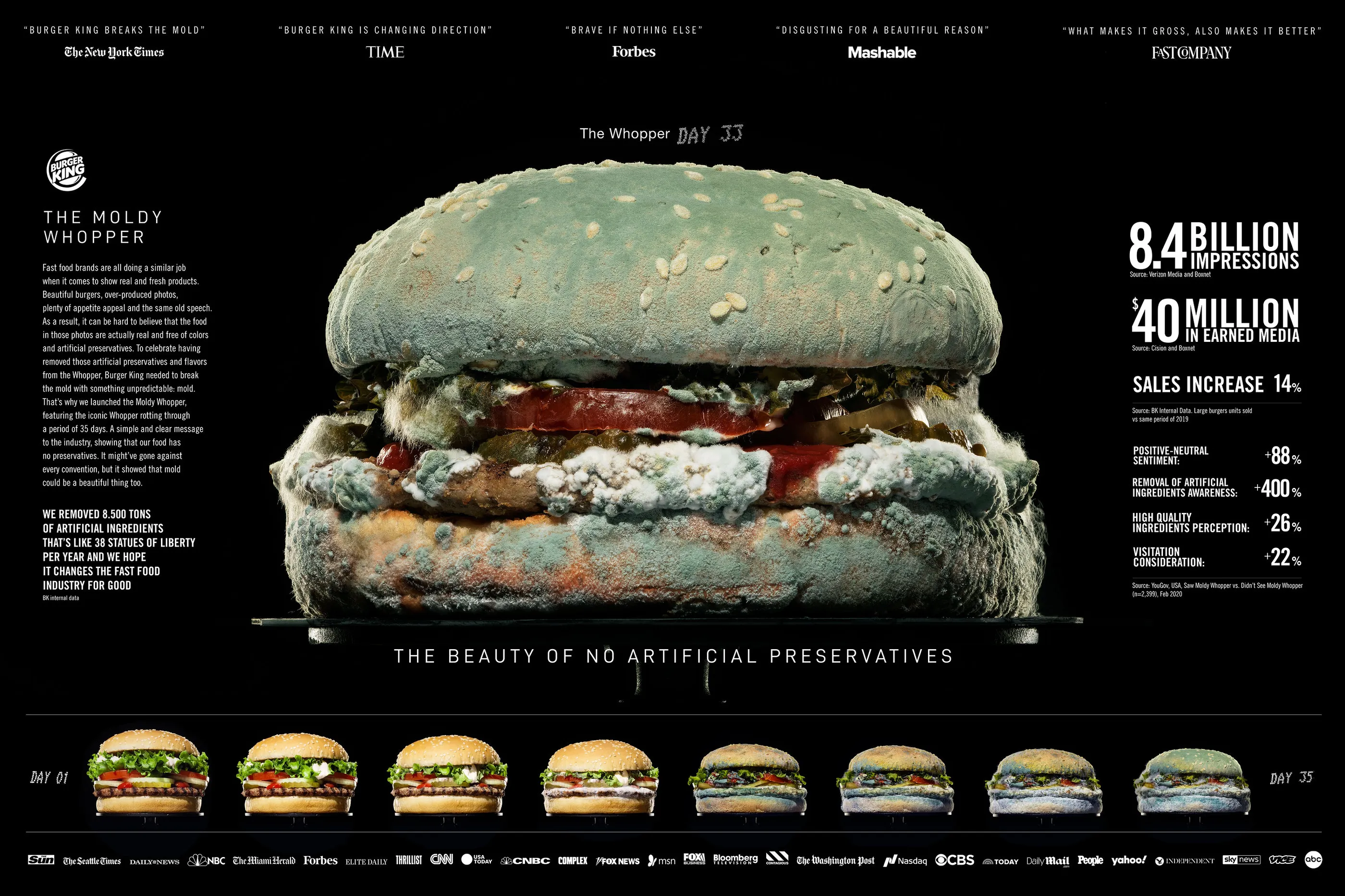
Burger King showed their flagship burger decomposing over 34 days — and won more advertising awards than any other campaign that year, because the rot was the proof.
Burger King showed a Whopper rotting.
Not suggested it, not implied it, not used clean stock photography of fresh ingredients while a voiceover talked about quality. They filmed a real Whopper, purchased from a real Burger King, sitting on a surface under controlled conditions for 34 days. They shot the whole thing time-lapse. They showed the bun growing green and blue mold. They showed the patty darkening. They showed the tomato and lettuce collapsing into the structural failure that real vegetables eventually experience.
Then they ran it as a national advertising campaign. The tagline was: “The beauty of no artificial preservatives.”
It won more advertising awards than almost any other campaign of 2020.
The Context
Fast food advertising has a complicated relationship with the product it advertises. There’s an entire photography genre (“food styling”) dedicated to making mass-produced food look like something a talented chef prepared for a magazine shoot. The gap between the burger in the advertisement and the burger on the tray has become so well documented and so widely understood that it’s essentially a cultural joke. Everyone knows; the industry does it anyway.
Burger King’s Global CMO Fernando Machado had been pushing against this convention for several years. The 2018 “Burning Stores” campaign had used real photographs of BK restaurants genuinely on fire to illustrate the “flame grilled since 1954” brand claim. That campaign won awards and established a template: find the honest, uncomfortable version of a brand truth and use it directly.
The product truth available for “Moldy Whopper” was substantial. Burger King had committed in 2018 to removing all artificial preservatives, colors, and flavors from its food by the end of 2020. This was a genuine product investment: it required supply chain changes, ingredient reformulation, and significant operational cost. The problem was communicating it. Clean photography of fresh ingredients is exactly what every fast food brand claims; there was no reason for a consumer to believe Burger King’s version over anyone else’s.
David Miami (BK’s primary creative agency), along with INGO Stockholm and Publicis Spain, developed the concept. The insight was precise: if the burger now rots naturally, show the rot. The rot is the proof.
The Campaign
A Whopper was purchased. It was placed under controlled conditions and filmed via time-lapse over 34 days. The footage was unmanipulated. What happened is what happens to real food that doesn’t contain artificial preservatives: it decomposed. On day 34, the Whopper was substantially covered in natural mold.
The 45-second film opened on a fresh, glossy Whopper, the standard food photography framing. Then the mold appeared and grew. The time-lapse accelerated 34 days into under a minute, making the visual transformation both beautiful (the mold patterns were genuinely photogenic in a macro-photography sense) and deeply unappetizing in the way that only honest food photography can be.
The campaign ran in the US in February 2020, alongside a print execution and social media content. The print ads showed the Whopper at various stages of decomposition. The tagline appeared at the end of each execution: “The beauty of no artificial preservatives.”
BK chose to run the campaign across markets where they had already completed the transition to preservative-free ingredients, ensuring the claim was true in every geography where the ad appeared.
Why It Worked
The campaign succeeded because it solved the fundamental problem of trust in fast food marketing.
Consumers have a well-calibrated skepticism toward fast food advertising claims. They’ve been seeing aspirational food photography and quality claims for decades; those claims have rarely corresponded to the product in the bag. This skepticism is rational and broadly shared. Any conventional campaign claiming “real ingredients” or “higher quality” starts from a position of consumer disbelief that no amount of creative execution can fully overcome.
The Moldy Whopper solved this by providing evidence rather than assertion. You cannot fake 34 days of mold growth to make a point about preservatives. The visual sequence from fresh burger to decomposed burger is a direct demonstration that no artificial preservatives were present to slow the process. The mold isn’t a problem; it’s the proof.
This represents a specific application of what advertising theorists call “costly signaling”: making a claim that would be too expensive to fake. Showing your product rotting is not something a brand with artificial preservatives can credibly do. By doing it, Burger King signaled that the claim was genuine in a way that no conventional advertising statement could.
The shock value also worked as earned media engine. The footage was genuinely surprising, violating every norm of food advertising, which made it worth sharing and discussing. Major news organizations covered it as a news story rather than just an ad, extending its reach far beyond the paid media budget. The controversy wasn’t bad publicity; it was precisely the kind of attention the campaign needed to communicate its message at scale.
The Results
The campaign won the Cannes Grand Prix for Creative Effectiveness in 2020, along with the One Show Best of Show, the D&D Black Pencil, and multiple Clio Awards. Industry recognition was as complete as it gets in advertising; essentially every major competition awarded it at the highest level.
Mainstream press coverage extended the campaign’s reach: news organizations including mainstream newspapers and television outlets reported on the campaign in their coverage of advertising trends, food industry practices, and corporate transparency. This earned media significantly multiplied the value of the original media buy.
The direct consumer sales impact is harder to quantify. Burger King doesn’t release granular marketing-attributed sales data, and 2020’s COVID-19 disruptions to the food service industry make any year-over-year comparison unreliable. What’s clear is that the campaign successfully communicated a genuine product improvement to a skeptical audience in a category where consumer trust is chronically low, and did so in a way that was impossible to dismiss as marketing spin.
The Lesson for Today’s Marketers
The Moldy Whopper is a useful case study for any marketer working in a low-trust category, which in 2025 increasingly means most categories.
The lesson isn’t “be shocking.” Shock is a tactic, not a strategy, and shock without a genuine product truth behind it produces the Pepsi Kendall Jenner result rather than the Moldy Whopper result.
The lesson is about the relationship between product investment and creative investment. The campaign was possible only because Burger King had made a real, expensive product commitment before the campaign existed. The creative idea (show the mold) was elegant, but it was derivative of the product decision. The sequence matters: make the product genuinely better, then find the most honest way to show what “better” looks like.
In categories where consumers are skeptical of advertising claims, the most persuasive advertising is direct demonstration rather than assertion. Assertions require trust to work. Demonstrations create trust. If your product can genuinely withstand the demonstration, use it. If it can’t, that’s not a creative brief problem. It’s a product problem.
Key Results
- Industry Recognition: Won the Cannes Lions Grand Prix for Creative Effectiveness; also won at One Show (Best of Show), D&D Black Pencil, and the Clios
- Earned Media: Covered by mainstream news organizations globally — not just marketing trade press — extending reach far beyond the paid media footprint
- Brand Differentiation: One of only two major fast food brands at the time to have removed all artificial preservatives from its menu items
- Product Claim Credibility: The visual evidence of natural decomposition directly proved the 'no artificial preservatives' claim in a way that conventional advertising could not
- Cultural Impact: Frequently cited in 2020 advertising retrospectives as the most genuinely innovative campaign of the year
SWOT Analysis
| Strengths | Weaknesses | Opportunities | Threats |
|---|---|---|---|
|
|
|
|
Key Takeaway
Transparency in advertising is only credible when the product can withstand the transparency — the Moldy Whopper worked because the mold was real, the claim was true, and the brand was willing to show you evidence rather than just make an assertion.