Avis "We Try Harder": The Campaign That Made Being Second an Advantage
In 1962, Avis was losing money and running a distant second to Hertz. DDB's solution was to say so out loud - and it's one of the most effective counter-positioning moves in advertising history.

- Brand
- Avis
- Year
- 1962
- Agency
- Doyle Dane Bernbach (DDB)
- Industry
- Automotive, Rental
In 1962, Avis had been losing money for thirteen consecutive years. They were the clear number two in the car rental market, well behind Hertz, with no obvious product advantage, no technological edge, and no compelling reason for a traveler to choose them over the market leader. Their advertising, such as it was, looked like everyone else’s advertising.
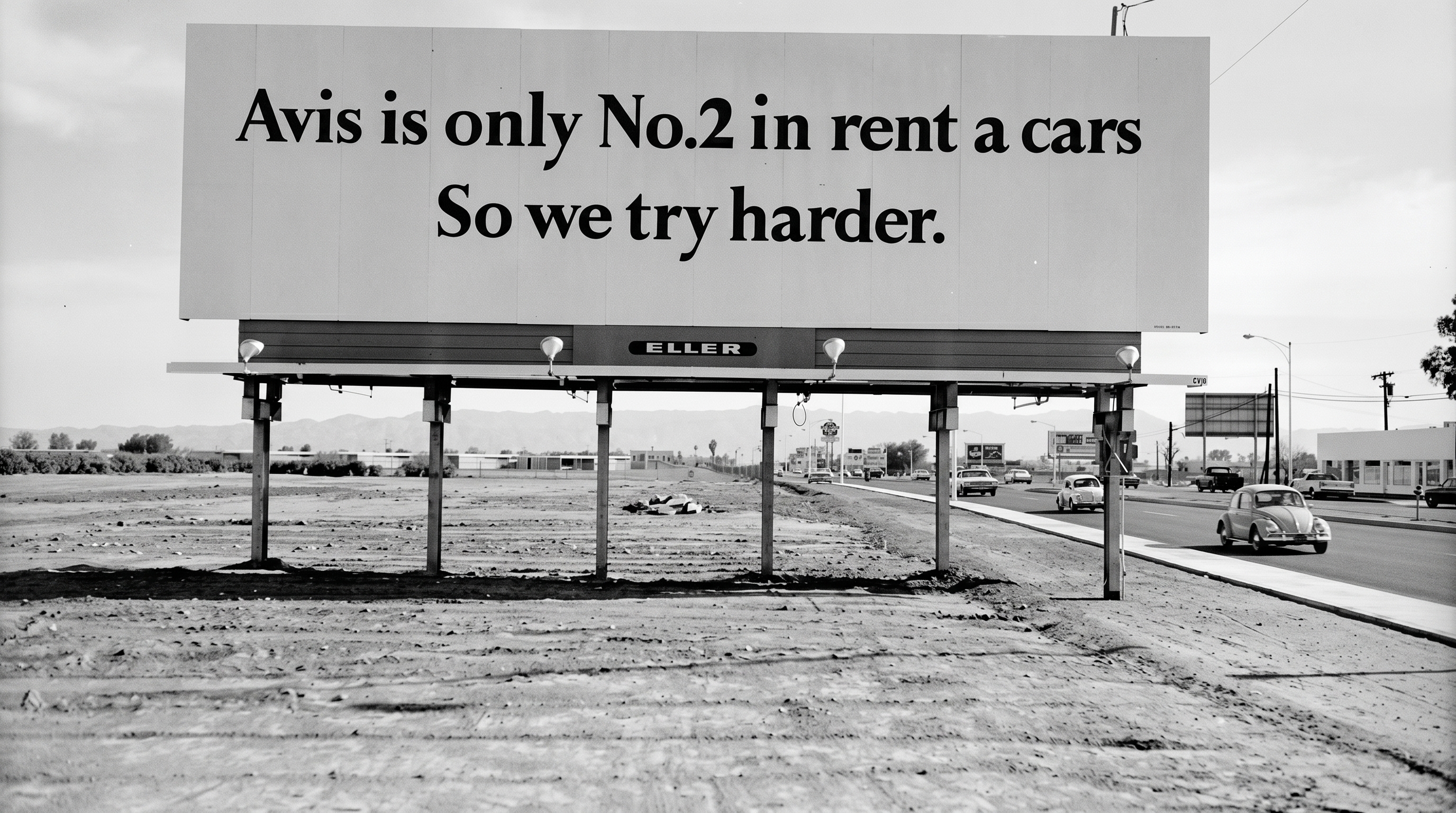
Then DDB wrote an ad that opened with: “Avis is only No. 2 in rent a cars. So why go with us?”
That sentence did something almost no advertising sentence had done before: it began with an admission of defeat. And then it explained why defeat was exactly the right reason to choose Avis.
The Context
Doyle Dane Bernbach in 1962 was already the most talked-about agency in American advertising. Their Volkswagen work, the “Think Small” and “Lemon” campaigns, had established DDB as the place that did things differently. Bill Bernbach’s philosophy was that advertising should treat readers as intelligent adults and that honesty, even about unflattering facts, built more durable credibility than any amount of polished claims.
Avis came to DDB in desperate shape. The company had operational challenges, a thin brand, and a number two market position that felt more like a ceiling than a starting point. The conventional response would have been to advertise harder on service, convenience, or price, to try to compete on the same dimensions as Hertz without acknowledging the gap.
Bernbach’s team, including copywriter Paula Green who is widely credited with the core idea, saw the situation differently. The number two position wasn’t something to hide. It was the most interesting thing about Avis, because it explained why Avis would work harder than a comfortable market leader would.
The insight was simple and lethal: market leaders get complacent. Hertz had no particular reason to obsess over clean ashtrays and short wait times and gassed-up cars. They already won. Avis, needing every customer, had every reason to care about the details. The “We Try Harder” line wasn’t just a tagline. It was a business logic made explicit.
The Campaign
The ads ran in print and made the argument directly, without hedging. “Avis is only No. 2 in rent a cars. So why go with us? We try harder.” The copy then listed specifics: shorter lines, newer cars, full ashtrays because Avis employees would notice them and feel embarrassed. The tone was matter-of-fact. It didn’t oversell the effort; it explained the incentive structure that made the effort rational.
One of the most effective executions leaned into the logic: “When you’re not the biggest, you have to be the best.” Another simply asked the reader to think about what happens to big companies when they stop having to compete for survival. The campaign’s running theme was that being second wasn’t a consolation prize; it was a competitive condition that produced better service.
What made the campaign genuinely unusual was what happened inside the company. Avis management adopted “We Try Harder” as an operational standard, not just a communications one. Employees wore “We Try Harder” buttons. Service standards were tightened to match the promise the ads were making. This mattered enormously because an advertising campaign built on a service promise that the service doesn’t keep is worse than no campaign at all; it crystallizes customer disappointment into active resentment.
The campaign and the operational reality had to move together. To their credit, at least in the early years, they did.
Why It Worked
The counter-positioning strategy works for a specific reason that’s easy to state and hard to execute: it makes the competitor’s strength a weakness.
Hertz’s dominance was real. You couldn’t argue that it wasn’t. But DDB found the hidden cost of that dominance: a market leader, by definition, doesn’t have the hunger of a challenger. By naming Hertz’s leadership explicitly and then using it as the explanation for Avis’s superior effort, the campaign turned Hertz’s own position against it. Every time Hertz’s advertising tried to claim superiority, they were implicitly confirming that they were the fat, comfortable number one that didn’t need to try as hard.
The credibility mechanics were also important. When a brand admits a weakness voluntarily, it generates a halo effect over everything else it claims. Avis saying “we’re number two” was so obviously true, and so obviously a thing that a company wouldn’t normally say about itself, that it made “we try harder” feel true by association. The admission functioned as proof. If they’re honest about the bad news, you’re more likely to believe the good news.
There’s also a consumer psychology dimension. Many people have a genuine sympathy for the underdog and a genuine skepticism toward market leaders. The “We Try Harder” framing gave those consumers a narrative framework for choosing Avis that felt principled rather than arbitrary. They weren’t just picking a car rental company; they were backing the scrappier competitor. That’s a more emotionally resonant transaction.
The Results
Avis moved from loss to profit within a year of the campaign’s launch, though separating the advertising effect from concurrent operational improvements is difficult. What’s clear is that the campaign coincided with a meaningful upswing in Avis’s business performance, and market share grew in the years that followed.
The longer result was durability. “We Try Harder” ran in various forms for over 50 years. That’s an extraordinary span for any campaign, and it reflects how deeply the positioning resonated. The line became genuinely synonymous with Avis in a way that most advertising taglines never achieve with their brands.
The internal adoption the campaign catalyzed also had lasting effects. The “We Try Harder” buttons and the operational standards that came with them created a company culture that, at its best, delivered on the promise. That feedback loop, advertising shaping behavior, which then validates the advertising, is what transforms a campaign into a brand.
The Lesson for Today’s Marketers
The DDB campaigns of the early 1960s, Volkswagen, Avis, and others, share a structural DNA that’s worth naming precisely. They all start by identifying the most obvious weakness or disadvantage in their client’s position, and then they explain why that disadvantage is actually evidence of something good.
VW’s car is small, which means it’s practical. Avis is second, which means it tries harder. In each case, the weakness is turned inside out not through clever spin but through a genuine logical argument. The car really is more practical. The challenger really does have a structural incentive to try harder. The campaign isn’t fabricating a counter-narrative; it’s finding the true counter-narrative that conventional advertising instinct would have hidden.
The practical application for any challenger brand is to ask: what does our position as the non-leader genuinely make us better at? Not what do we wish we were better at, but what does the incentive structure of our situation actually produce? If you can answer that honestly, you have the foundation of a counter-positioning campaign. The hardest part, then, is being willing to say the uncomfortable thing first.
Independent specialists apply the same logic: a focused SEO expert in Kerala works a smaller book of clients with more accountability than a large agency ever could, and that structural fact is itself the pitch.
Say your weakness out loud. Say it before your competitor can use it against you. Then explain why it’s actually the reason to trust you. That sequence, done right, is one of the most underused moves in advertising.
Key results
Avis went from losing money to its first profitable year in more than a decade within a year of the campaign's launch
Avis's market share grew meaningfully in the years following the campaign launch, closing some of the gap with Hertz
'We Try Harder' ran for over 50 years in various forms, making it one of the longest-running positioning lines in advertising history
'We Try Harder' buttons were worn by Avis employees as an operational commitment, not just a marketing slogan
SWOT analysis
S Strengths
- The honest admission of second place was so unexpected that it functioned as a credibility signal for everything else Avis claimed
- Counter-positioning against Hertz gave Avis a permanent frame: every customer who felt that big market leaders get complacent had a reason to choose Avis
- The campaign required and reinforced genuine operational improvement, making the advertising and the product experience mutually supporting
W Weaknesses
- The positioning permanently defined Avis in relation to Hertz, making it difficult to ever claim category leadership without abandoning the identity
- The 'trying harder' promise raised customer expectations; any service failure was measured against the explicit commitment in a way it wouldn't be for other brands
O Opportunities
- The underdog framing generates natural consumer sympathy, particularly among customers who distrust dominant market players
- The positioning became a template for challenger brand strategy that Avis could refresh and reapply across decades
T Threats
- Hertz eventually responded with advertising that directly addressed the comparison, reducing some of the asymmetric benefit Avis was extracting
- Budget competitors like National and later Enterprise created a three-way market that made the Hertz-vs.-Avis frame less central to consumer choice
Naming your weakness before your competitor does strips it of its power and converts an obvious vulnerability into a proof point for every other claim you make.
Frameworks at play
Perceptual Positioning Map
A visual tool that plots competing brands on two axes to reveal how customers actually perceive them - and where the gaps in the market live.
Read the framework → Strategy · Competitive AnalysisPorter's Five Forces
A structural framework for diagnosing the competitive intensity of any industry by mapping five forces that shape long-term profitability.
Read the framework → Strategy · Competitive PositioningPorter's Generic Strategies
Three fundamental approaches to competitive advantage: be the cheapest, be the most distinct, or dominate a narrow segment. Pick one and commit.
Read the framework → Core Marketing · StrategySTP Marketing (STP)
STP is the strategic backbone most campaigns are missing. Before you write a word of copy or pick a channel, you need to know who you're talking to, which slice of them you're actually serving, and what you want them to believe about you.
Read the STP → Analysis · StrategySWOT Analysis (SWOT)
SWOT is the most widely used strategic framework in business, which also makes it the most widely misused. Done honestly, it's a clarifying tool. Done defensively, it produces a flattering fiction.
Read the SWOT →Concepts in this case study
- Brand PositioningFull guideBrand positioning explained with the Avis We Try Harder campaign: what positioning is, h…
- Challenger BrandA challenger brand competes against category leaders not by matching their resources but…
- Growth HackingGrowth hacking is a process of rapid, low-cost experimentation across marketing and prod…
- Unique Selling PropositionA unique selling proposition is the specific reason a customer should choose you over an…
Enjoying our content? Make us a preferred source on Google.
Add as Preferred Source