
The ALS Ice Bucket Challenge: How a Viral Fundraising Mechanic Changed Nonprofit Marketing
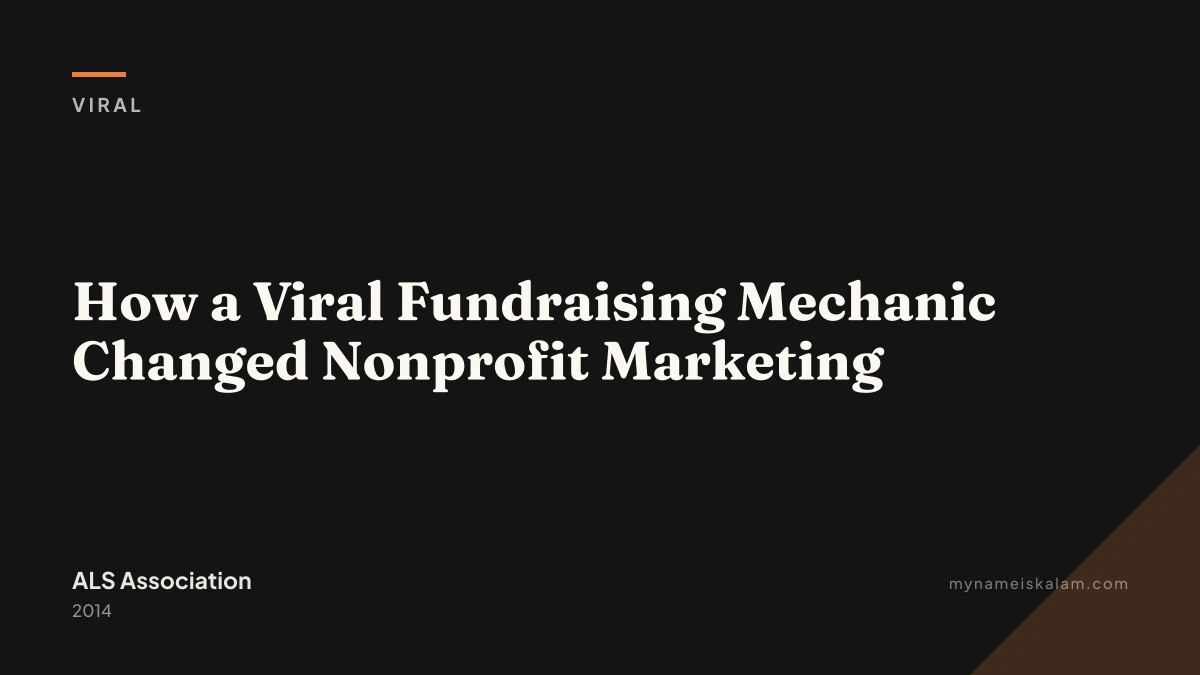
In the summer of 2014, a grassroots ice-water stunt raised over $115 million for ALS research in two months, funded a gene discovery, and rewrote the rules for how nonprofit campaigns spread.

- Brand
- ALS Association
- Year
- 2014
- Industry
- Nonprofit, Health
In July 2014, Pat Quinn and Pete Frates, both living with ALS, helped spread a challenge that had begun circulating in the golf and athletic communities: dump ice water on your head, film it, nominate three people, donate to ALS research. By August, Bill Gates was on camera pouring a bucket over himself in his garage. George W. Bush followed. Oprah Winfrey. Mark Zuckerberg. LeBron James. Roughly 17 million people uploaded their own versions to Facebook. The ALS Association, which had been raising around $2.8 million in a typical summer, raised $115 million in two months.
No agency planned this. No campaign manager approved a brief. A mechanic that could have stayed within a small athletic network somehow became the most successful grassroots fundraising event in history, and the why of it is worth pulling apart carefully.
The Context
Amyotrophic lateral sclerosis, known as ALS or Lou Gehrig’s disease, is a progressive neurodegenerative condition that attacks the motor neurons controlling voluntary muscle movement. It’s ultimately fatal; the median survival from diagnosis is two to five years. It affects roughly 30,000 Americans at any given time and about 5,000 new cases are diagnosed annually in the U.S.
Before summer 2014, the ALS Association was a modestly funded research and advocacy organization. Its annual fundraising ran to tens of millions of dollars total. ALS received significantly less research funding relative to its mortality impact than comparable diseases, partly because of lower public profile. Most people knew the name from baseball history (Lou Gehrig retired in 1939) and the physicist Stephen Hawking, who lived with an unusually slow-progressing form for decades. The human cost of the disease’s typical progression was not widely understood.
The ice bucket challenge existed before it became an ALS fundraiser. A version circulated in sports circles as a general dare or acknowledgment mechanic. Pete Frates, a former Boston College baseball captain who was diagnosed with ALS in 2012 and had lost the ability to speak by the time the challenge went viral, had been using social media consistently to raise awareness about his condition. When the challenge began circulating in his network in July 2014, it became attached to ALS fundraising through the efforts of Frates, Quinn, and their supporters. What began as a personal network activation became something no one could have predicted or planned.
The Campaign
The mechanics were simple to the point of elegance, though “simple” undersells the specific features that drove spread.
You filmed yourself pouring ice water over your head. You named three people who had 24 hours to either do the same or donate to the ALS Association (later versions conflated the options: you did the challenge and donated). You posted the video to social media. The clip was short, shareable, and broadly funny to watch regardless of who was doing it: the shock of cold water produces a reliable physical reaction that reads well on video.
The nomination element was the crucial mechanic. This wasn’t a passive invitation to participate. It was a direct, public call-out. Your name appeared in a video watched by your network. Declining meant explaining your absence in a space where others were clearly participating. The social pressure was real, and it operated across every level of social hierarchy simultaneously: within friend groups, within organizations, between celebrities and their fans, and between public figures and their peers.
The timing mattered more than is usually acknowledged. August 2014 was not a random moment. Facebook’s native video feature had launched earlier that year, making it significantly easier to post and watch short clips without leaving the platform. Smartphone cameras were ubiquitous and high-quality. The combination of those technical factors with the challenge’s particular visibility (outdoor, water, summer) meant that the production and sharing barriers were as low as they had ever been.
Why It Worked
Several things aligned in ways that are separable and instructive.
The peer nomination mechanic converted passive sympathy into active participation through social obligation. Charitable appeals typically ask strangers to care about something they have no personal stake in. The ice bucket challenge asked you to respond to a specific request from someone you actually knew, in public, with your silence or refusal as visible as your participation. That’s a fundamentally different psychological dynamic.
The activity itself was a feature rather than a tax. Dumping cold water on yourself is briefly unpleasant but also funny, photogenic, and shareable. People got something from doing it: social visibility, a moment of mild bravery, participation in a collective event with high cultural salience. The “cost” of participating was essentially zero relative to the social return. This is different from most charitable asks, where the cost (time, money, attention) is real and the social return is private or nonexistent.
Celebrity participation created an aspirational loop. When Bill Gates posted his video, it was covered by news organizations as a story in itself. That coverage introduced the challenge to people who hadn’t encountered it through their own networks. Each wave of high-profile participation renewed the news cycle, which drove further ordinary participation, which attracted more attention.
The criticism the campaign received was also partially correct. “Slacktivism” - the charge that people were performing social virtue without actual cost or sacrifice - was a real phenomenon. Many participants completed the challenge without donating. The original mechanic positioned the challenge as an alternative to donation rather than a complement to it. The ALS Association itself had to adapt its messaging during the campaign to emphasize donation rather than the physical challenge.
The Results
The headline is $115 million raised in two months, compared to $2.8 million in the same period in 2013. Approximately 2.5 million new donors gave to the ALS Association during the campaign period. Many of these were first-time donors who had no prior relationship with the organization.
The research impact materialized over the following years. Funding contributed to a global collaboration involving researchers at 11 institutions that identified NEK1, a gene whose variants contribute to approximately 3% of ALS cases. The finding, announced in 2016, was described by project researchers as a significant step toward understanding the disease’s genetic underpinning and a potential target for therapeutic development. This was directly attributable to the 2014 fundraising.
The campaign’s longer-term sustainability was a genuine limitation. ALS Association fundraising returned toward pre-campaign levels in subsequent years. The spike was extraordinary but did not permanently reset the organization’s donor base at scale. The 2.5 million new donors were largely one-time givers rather than recurring supporters, which is the more valuable long-term asset for a nonprofit.
The Lesson for Today’s Marketers
The Ice Bucket Challenge is studied for the wrong reason almost as often as for the right ones. It’s frequently cited as proof that “authentic” or “grassroots” campaigns outperform planned ones, which is true but unhelpful: you can’t plan an authentic moment, and trying to manufacture one usually produces something that feels worse than nothing.
The more applicable lesson is mechanical. The challenge worked because of specific structural features: peer nomination (not general invitation), public visibility (not private donation), and near-zero participation cost (pour water, not sign a petition). Each of these lowered a friction point that typically kills charitable spread.
The limitation the campaign exposed is equally instructive. Social mechanics drive participation. Participation doesn’t automatically become donation. The gap between “person who did the challenge” and “person who gave money” was large, and bridging it required an additional step that many participants never took. If you’re building a viral mechanic for a charitable cause, the donation trigger has to be embedded in the mechanic, not offered as an alternative to it.
The Ice Bucket Challenge also produced real science, which matters both for the people affected by ALS and for the campaign’s legacy. The NEK1 finding is the kind of outcome that justifies every skeptical question about whether attention-driven fundraising produces actual progress, or whether it produces $115 million and a lot of wet celebrities. This time, it produced both.
Key results
The ALS Association raised over $115 million between June and August 2014, compared to $2.8 million during the same period in 2013
Approximately 2.5 million new donors gave to the ALS Association during the campaign period
Funding contributed to the identification of the NEK1 gene variant as a contributor to ALS, announced in 2016, described by researchers as a major step toward understanding the disease
More than 17 million people uploaded Ice Bucket Challenge videos to Facebook; over 440 million people watched them, generating 10 billion video views
Bill Gates, Oprah Winfrey, Mark Zuckerberg, George W. Bush, and Lebron James were among the high-profile participants, generating enormous secondary coverage
SWOT analysis
S Strengths
- The peer nomination mechanic created social obligation: you were specifically named, and declining was a visible act in front of your network
- The activity was low-cost, safe, easily filmed, and funny to watch; the barrier to participation was almost zero
- The challenge spread during summer, when social media activity is high and outdoor, water-based activities are contextually appropriate
- Celebrity participation created aspirational modeling: ordinary people could do the same thing that Bill Gates was doing
W Weaknesses
- Many participants completed the challenge without donating: the original mechanic's nominal 'alternative' to donating was doing the challenge, which many people did instead of giving
- The campaign's sudden scale overwhelmed the ALS Association's donor management and communications infrastructure
- The challenge created a fundraising spike that the ALS Association could not sustain; subsequent years saw a sharp return to pre-campaign donation levels
O Opportunities
- The campaign demonstrated that a clear, simple, shareable mechanic could generate nonprofit fundraising results that paid media budgets rarely achieve
- The NEK1 research outcome gave the campaign a concrete scientific legacy that validated the funds raised and offered a proof point for future charity-adjacent viral campaigns
T Threats
- The 'slacktivism' critique was widespread and at least partially valid: participation gave people a feeling of contribution without the financial contribution the charity needed
- The campaign's success inspired imitators, most of which failed and some of which damaged charitable credibility by being seen as exploitative
- Questions emerged about ALS Association overhead and administrative spending, temporarily diverting media attention from the campaign's positive aspects
The most effective viral fundraising mechanics combine social visibility, low barrier to entry, and genuine peer obligation - but without a clear donation trigger built into the mechanic, awareness doesn't automatically convert to money.
Want help growing your brand on social? See my social media marketing service. Or see all my services.
Enjoying our content? Make us a preferred source on Google.
Add as Preferred Source